What Do 5-Year-Old Autistic Kids Like to Watch?
If you are navigating the world of media with a neurodivergent child, you have likely noticed that their viewing habits look quite different from those of their neurotypical peers. You might be wondering, exactly what do 5-year-old autistic kids like to watch? You are not alone in asking this. While many children at this age are drawn to fast-paced, loud, and action-packed cartoons, autistic children often gravitate toward entirely different types of content.
For a 5-year-old on the autism spectrum, screen time is rarely just about passing the time or simple entertainment. Television shows, movies, and YouTube videos often serve as vital tools for emotional regulation, language acquisition, and sensory processing. A carefully chosen show can provide a safe, predictable haven in a world that often feels chaotic and overwhelming.
Understanding why your child prefers certain shows—and why they might watch the exact same five-minute clip twenty times in a row—can transform how you view their screen time. By looking through the lens of an autistic child’s unique processing needs, parents and caregivers can intentionally curate a media library that supports their development, respects their sensory boundaries, and brings them genuine joy.
Understanding How a 5-Year-Old Autistic Mind Processes Media
To understand what 5-year-old autistic children enjoy watching, we first have to look at how their brains process incoming information. Autistic children experience the world differently, and this extends directly to how they consume digital media.
The Deep Need for Predictability and Routine
For many autistic children, the unpredictability of daily life can trigger anxiety. Social interactions, schedule changes, and even the sensory environment are constantly shifting. Television provides the exact opposite experience. A recorded video is completely static; the characters will say the exact same words, in the exact same tone, at the exact same time, every single viewing.
This predictability is incredibly soothing. When a 5-year-old child knows exactly what is going to happen next, their cognitive load drops. They do not have to work hard to anticipate surprises or decode unexpected social cues. This allows their nervous system to relax.
Sensory Processing Differences on Screen
Many popular children’s cartoons are visually and auditorily chaotic. They feature rapid scene cuts, flashing bright colors, overlapping dialogue, and sudden, loud sound effects. For a child with sensory processing differences, this rapid-fire sensory input can quickly lead to overstimulation and meltdowns.
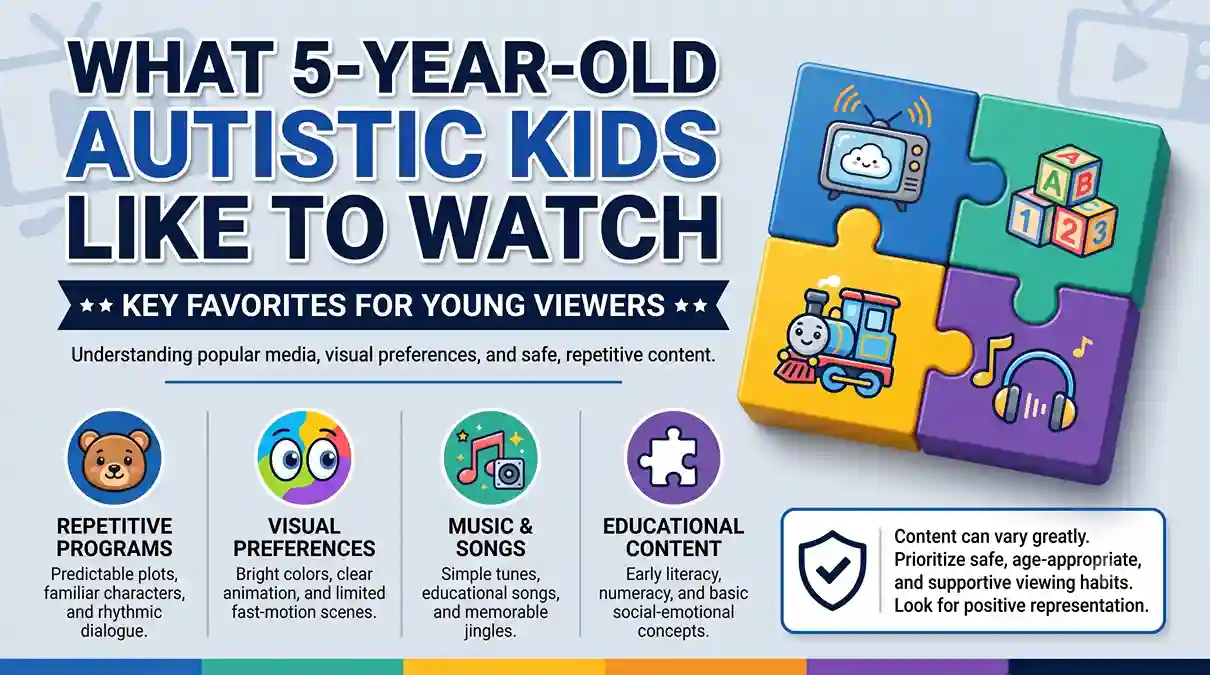
Autistic kids generally prefer content that respects their sensory thresholds. This often translates to shows with slower pacing, longer scene holds, muted or pastel color palettes, and calm, gentle audio. They often prefer single-voice narration over scenes where multiple characters talk over one another.
Special Interests and Hyperfocus
By the age of five, many autistic children have developed strong, highly specific special interests. Whether it is a deep fascination with trains, planetary systems, numbers, vacuum cleaners, or specific animal species, these interests will heavily dictate their viewing preferences. Content that aligns with a child’s special interest is highly regulating and deeply engaging, often holding their attention far better than standard narrative cartoons.
Key Features of Autism-Friendly TV Shows and Videos
When evaluating whether a new program will be a good fit for your child, it helps to look for specific structural elements. While every autistic child is entirely unique in their preferences, the most widely embraced autism-friendly media typically shares these core characteristics:
Calm Pacing and Reduced Visual Clutter
Shows that do not rely on constant action sequences allow children time to process the information on the screen. A minimalist visual style—such as characters set against a solid white background—helps children focus on the core interaction without being distracted by unnecessary background details.
Clear, Literal Communication
Autistic children often take language very literally and may struggle to interpret sarcasm, complex idioms, or subtle nonverbal cues. Programs that utilize direct, clear, and literal language are much easier for them to understand. Shows that explicitly label emotions (e.g., “I am feeling frustrated right now because my block tower fell”) provide excellent modeling.
Social-Emotional Modeling
Navigating social expectations is a common challenge for children on the spectrum. The best media acts as a gentle social story, breaking down complex social interactions into manageable steps. Shows that pause to explain why a character is sad, or demonstrate step-by-step how to take turns, offer safe, repeatable lessons that children can eventually apply in the real world. Many parents begin noticing these benefits early on, even when researching the signs of autism in 3 year old toddlers, as early intervention often incorporates structured media.
The Best TV Shows for 5-Year-Old Autistic Kids
Based on recommendations from speech-language pathologists, child psychologists, and neurodivergent advocates, here are some of the most beneficial and beloved shows for 5-year-old autistic children.
Daniel Tiger’s Neighborhood
Considered a gold standard for social-emotional learning, Daniel Tiger’s Neighborhood is brilliantly structured for autistic minds. The show uses catchy, repetitive musical jingles to teach coping strategies for everyday challenges—such as feeling mad, trying new foods, or going to the doctor. The pacing is deliberate, and characters frequently break the fourth wall to speak directly to the viewer, providing clear, unambiguous social cues.
Bluey
While Bluey has captured the hearts of neurotypical and neurodivergent children alike, it is particularly wonderful for autistic kids. The episodes are short (around seven minutes), which is perfect for managing attention spans. The show excels at modeling imaginative play and demonstrates healthy family dynamics in a gentle, highly relatable way. The sensory environment of the show is also very grounded, relying on natural acoustic music rather than jarring sound effects.
Sesame Street
Sesame Street remains a staple because of its distinct, predictable segment structure. Furthermore, the introduction of Julia, a Muppet who is autistic, has been a monumental step in representation. Julia exhibits common autistic traits, such as sensory sensitivities and utilizing a communication device, which helps normalize these experiences for autistic viewers and teaches acceptance to their peers.
Pablo
Pablo is a groundbreaking show specifically designed for and by the autistic community. It follows a 5-year-old autistic boy who uses his magic crayons to turn his life challenges into animated adventures. The animal characters in his imaginary world represent various facets of the autistic experience. Because there is a vast spectrum and different type of autism presentations, Pablo beautifully captures how diverse autistic traits can be, providing incredible representation and validation for neurodivergent kids.
Puffin Rock
For children who require low-stimulation environments, Puffin Rock is a masterpiece. Narrated with a calm, soothing voice, the show features beautiful watercolor-style animation and explores gentle nature themes. The background audio consists of soft nature sounds rather than loud music, making it an ideal choice for winding down before bed or recovering from a sensory meltdown.
Pocoyo
Pocoyo is highly recommended for children who are easily visually overwhelmed or those who are gestalt language processors. The show places brightly colored, distinct characters against a completely blank white background. The narration is simple, the visual comedy is highly exaggerated and easy to read, and the language is clear and sparse.
Numberblocks
For children who have a strong affinity for numbers, patterns, or systematizing, Numberblocks is endlessly fascinating. It visually breaks down complex mathematical concepts in a colorful, predictable way. Many autistic children who are hyperlexic or deeply interested in systems find immense comfort and joy in the structured logic of this program.
Top Educational and Autism-Friendly YouTube Channels
In addition to traditional television shows, YouTube offers highly specific, targeted content that many parents utilize for therapeutic and educational purposes.
Super Simple Songs
This channel is a staple in many special education classrooms. The animations are clean, the tempo of the music is specifically slowed down for easier auditory processing, and the lyrics are highly repetitive. It is exceptional for teaching basic vocabulary, action verbs, and encouraging imitation.
Songs for Littles (Ms. Rachel)
Created by a teacher and a speech-language pathologist, this channel uses evidence-based techniques to encourage language development. Ms. Rachel uses close-up shots of her mouth, exaggerated facial expressions, and strategic pausing to encourage viewers to vocalize. This can be particularly engaging for children working on expressive language skills.
Speech and Language Songs
Run by a licensed speech-language pathologist, this channel is specifically designed to support speech production and articulation. The songs are structured to help children practice specific phonemes and early language concepts in a low-pressure, highly engaging musical format.
Why Do Autistic Children Watch the Same Shows Over and Over?
If you have a 5-year-old on the spectrum, you are likely very familiar with “the loop”—the intense desire to watch the exact same movie, episode, or even a specific 30-second scene on repeat for weeks or months at a time.
This repetitive viewing is not a bad habit that needs to be broken. For autistic individuals, repetition is a powerful form of self-regulation. Knowing exactly how a story will unfold provides a profound sense of safety and control.
Additionally, many autistic children are Gestalt Language Processors. Instead of learning language word-by-word, they learn language in “chunks” or scripts. By watching the same scene repeatedly, they are absorbing the emotional context, the intonation, and the exact phrasing of a script. They may later use this exact script (a process known as echolalia) to communicate their own feelings in real life. When your child quotes a line from a cartoon out of context, they are often trying to communicate the underlying emotion of that scene to you.
Managing Screen Time and Preventing Meltdowns
While screen time can be a wonderful tool, transitioning away from the tablet or television is a notorious trigger for meltdowns. Managing these transitions requires structure and empathy.
Using Visual Timers
Because the concept of time is abstract, simply telling a 5-year-old they have “five more minutes” rarely works. Utilizing visual timers—like a sand timer or a color-fading digital clock—helps make the passage of time concrete and predictable.
Practice Co-Viewing
Whenever possible, watch media alongside your child. You can use their favorite shows as a bridge for connection. If they love Daniel Tiger, sing the songs with them when they are frustrated. Co-viewing transforms screen time from an isolating activity into a shared social experience, allowing you to model language and observe what specifically captures their attention.
Navigating Overstimulation and Comorbidities
Even with calm shows, the light and sound emitted from screens can eventually fatigue a child’s nervous system. It is important to watch for signs of dysregulation, such as increased vocal stimming, physical restlessness, or irritability. For children navigating complex profiles, such as an adhd and autism diagnosis, setting clear boundaries around when screens are available (e.g., not within an hour of bedtime) is crucial to prevent sleep disturbances and support executive functioning.
FAQ: Screen Time and Autism in 5-Year-Olds
Is it normal for my autistic 5-year-old to only watch the credits of a movie?
Yes, this is incredibly common. Movie credits feature scrolling text, high-contrast visuals, and predictable music. For a child who loves visual patterns or is hyperlexic, the credits are often the most sensory-pleasing and regulating part of the entire film.
How much screen time is appropriate for a 5-year-old on the autism spectrum?
While pediatric guidelines suggest limiting screen time, professionals working with neurodivergent children often take a more nuanced approach. Focus less on the exact number of minutes and more on the quality and purpose of the screen time. If a video is helping your child regulate after a stressful day or facilitating speech, it is serving a positive therapeutic purpose.
Can TV shows help my nonspeaking autistic child learn to communicate?
Absolutely. Many nonspeaking or minimally speaking children use scripts from their favorite shows to express themselves. Media can also introduce sign language, model the use of AAC (Augmentative and Alternative Communication) devices, and teach foundational receptive language skills through visual repetition.
Why does my child get upset when a new episode of their favorite show plays?
An unexpected new episode breaks the routine. The child was seeking the comfort of a known narrative, and the new episode introduced unpredictable variables, which can feel jarring and anxiety-inducing. Always warn your child if a new episode is going to play.
Should I discourage my child from watching shows meant for younger toddlers?
No. Content designed for toddlers often perfectly aligns with the sensory processing needs of autistic children. The slower pacing, simple language, and direct social modeling found in preschool shows remain highly beneficial and regulating, regardless of the child’s chronological age.
Conclusion
Determining what 5-year-old autistic kids like to watch ultimately comes down to understanding their unique neurological needs. By prioritizing predictability, sensory-friendly design, and clear social modeling, you can turn screen time into a deeply supportive aspect of your child’s daily routine. Rather than fighting their viewing preferences, embrace their love for repetition and special interests. When used thoughtfully, media is not a barrier to your child’s development—it is a bridge to communication, emotional regulation, and shared joy.