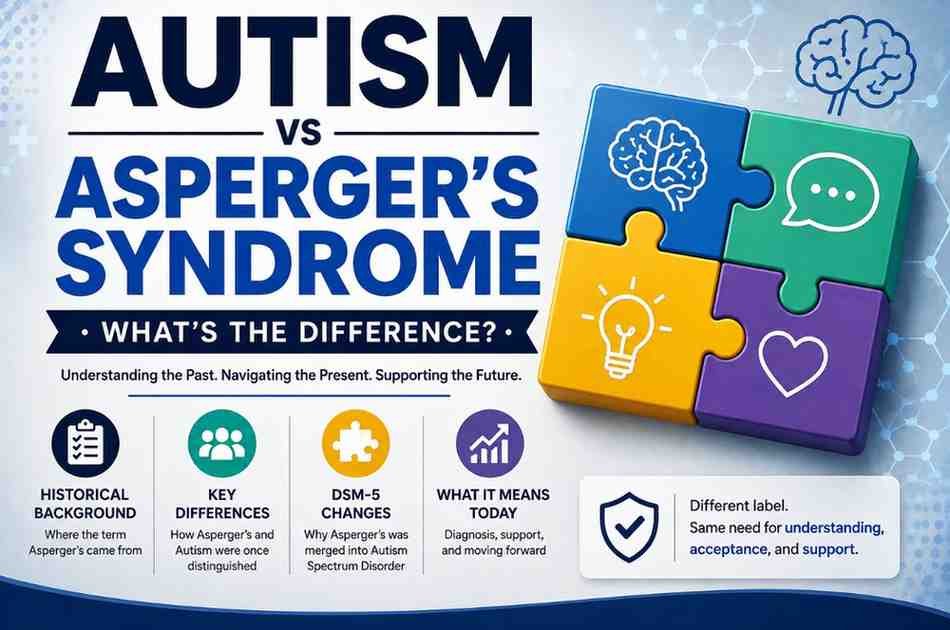
Autism vs Asperger’s Syndrome: What’s the Difference?
If you grew up hearing the term “Asperger’s” or received that diagnosis yourself, you’ve probably noticed something strange: doctors don’t use the word anymore. Ask a pediatrician or psychologist today about Asperger’s, and most will tell you it’s simply not a diagnosis they can give. That single fact confuses a lot of families searching for autism vs Aspergers information, and it’s the reason this comparison keeps coming up in doctors’ offices, parenting forums, and late-night Google searches.
Asperger’s syndrome hasn’t disappeared as a set of traits, but it disappeared as an official diagnosis back in 2013. What used to be called Asperger’s is now diagnosed as autism spectrum disorder, usually at Level 1, the classification for autistic people who need the least amount of daily support. Everything else — the traits, the strengths, the challenges — still exists. Only the label changed.
This guide breaks down exactly what happened, why it happened, and what it actually means for anyone trying to understand where Asperger’s fits into the autism spectrum today.
Autism Spectrum Disorder vs Asperger’s Syndrome: The Quick Comparison
| Asperger’s Syndrome (pre-2013) | Autism Spectrum Disorder (current) | |
|---|---|---|
| Official diagnosis? | No — retired from the DSM in 2013 | Yes — the only diagnosis currently used |
| Diagnostic manual | DSM-IV (1994–2013) | DSM-5 and DSM-5-TR |
| Defining feature | Social and behavioral differences without significant language or cognitive delay | A spectrum of traits ranging from minimal to substantial support needs |
| Modern equivalent | Roughly corresponds to Level 1 ASD | N/A — ASD is the umbrella term |
| Who uses the term today | Some individuals, as a personal or cultural identity | Clinicians, researchers, schools, and insurance systems |
What Asperger’s Syndrome Used to Mean
Asperger’s syndrome was first described by Austrian pediatrician Hans Asperger in 1938 and detailed further in a 1944 paper on what he called “autistic psychopathy.” His work went largely unnoticed outside Austria for decades. That changed in 1981, when British psychiatrist Lorna Wing published a paper in Psychological Medicine that introduced Asperger’s observations to English-speaking clinicians and coined the term “Asperger syndrome” in his honor.
Wing’s paper helped shape how the condition was understood, though her description differed in some ways from Asperger’s own writing. By 1994, the American Psychiatric Association added Asperger’s disorder as a distinct diagnosis in the fourth edition of the Diagnostic and Statistical Manual of Mental Disorders (DSM-IV).
Under those DSM-IV criteria, a person could be diagnosed with Asperger’s if they showed:
- Persistent difficulty with social interaction and nonverbal communication, such as reading facial expressions or body language
- Restricted, intense, or highly focused interests
- Repetitive behaviors or routines
- No significant delay in early language development
- No significant delay in cognitive development or self-help skills (in most cases, average or above-average IQ)
That last point — no language delay — was the key feature separating Asperger’s from what clinicians at the time called “classic autism” or “autistic disorder.”
A Note on Hans Asperger’s History
It’s worth knowing that Hans Asperger’s legacy is more complicated than early accounts suggested. Historical research published in 2018 by medical historian Herwig Czech documented that Asperger worked in Nazi-era Vienna and had professional ties to child “euthanasia” programs, including referring some children to the Spiegelgrund clinic, where dozens of children with disabilities died. This history was largely unknown when Wing popularized his name in 1981, and it has led some clinicians and advocacy organizations to move away from the eponym entirely — one more reason, alongside the DSM-5 changes, that “Asperger’s” has fallen out of clinical use.
Aspergers vs Classic Autism: Why the Terms Got Confusing
Before 2013, the DSM-IV actually listed five separate diagnoses under a category called Pervasive Developmental Disorders:
- Autistic disorder (often called “classic autism”)
- Asperger’s disorder
- Pervasive developmental disorder, not otherwise specified (PDD-NOS)
- Rett syndrome
- Childhood disintegrative disorder
In everyday conversation, “classic autism” or “autistic disorder” generally referred to cases involving delayed speech, more noticeable communication challenges, and sometimes intellectual disability. Asperger’s described people with similar social and behavioral traits but typical or advanced language skills and average-to-high IQ.
The problem was that these categories overlapped constantly. Two clinicians evaluating the exact same child could reasonably land on different diagnoses depending on how they weighed language history, testing conditions, or even the child’s mood that day. Research comparing children with Asperger’s and children with high-functioning autism repeatedly found more similarities than differences between the groups, which raised a hard question for the people writing the next edition of the DSM: if two “different” diagnoses can’t be reliably told apart, are they really different conditions?
Why the DSM-5 Merged Asperger’s Into Autism Spectrum Disorder
When the American Psychiatric Association released the DSM-5 in 2013, it eliminated all five Pervasive Developmental Disorder subtypes and replaced them with one diagnosis: autism spectrum disorder (ASD). Asperger’s disorder, autistic disorder, and PDD-NOS were folded into this single category.
The DSM-5 workgroup gave a few core reasons for the change:
- Unreliable boundaries. Clinicians across different centers were applying the older categories inconsistently, which meant a child’s diagnosis sometimes depended more on which doctor they saw than on their actual presentation.
- Shared underlying traits. Research increasingly showed that autism, Asperger’s, and PDD-NOS reflected the same core difficulties with social communication and repetitive behavior, just expressed with different intensity.
- A better clinical model. A single spectrum diagnosis, paired with severity levels and specifiers, was seen as a more accurate way to describe how autism actually varies from person to person.
The diagnostic criteria changed too. DSM-IV required impairment in three separate areas — social interaction, communication, and repetitive behavior. DSM-5 condensed this to two domains: persistent deficits in social communication and social interaction, plus restricted or repetitive patterns of behavior, interests, or activities.
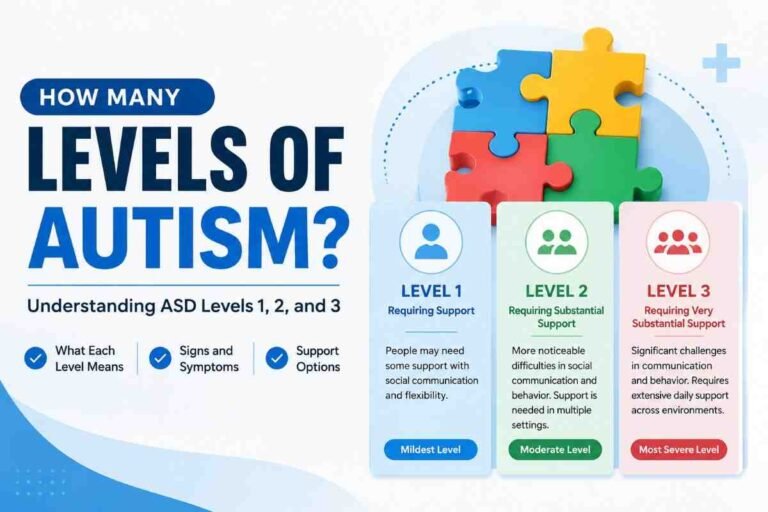
To capture the range of support people need, DSM-5 also introduced three severity levels:
- Level 1 — Requires support. This is where most people who previously received an Asperger’s diagnosis now fall.
- Level 2 — Requires substantial support.
- Level 3 — Requires very substantial support. If you want a deeper look at what this level involves day to day, our guide to Level 3 autism covers the diagnostic criteria and support needs in detail.
Asperger’s vs High-Functioning Autism: Are They the Same Thing?
This is one of the most common follow-up questions, and the honest answer is: mostly, but not officially. “High-functioning autism” was never a formal DSM diagnosis. It was a casual term clinicians and families used to describe autistic people with average or above-average IQ, regardless of whether their formal diagnosis was Asperger’s or autistic disorder.
Studies comparing the two groups before the DSM-5 change found real overlap in cognitive ability, school functioning, and social challenges, but also some measurable differences — for example, some research found that children with Asperger’s tended to have stronger verbal skills and later, less pronounced language delays than children labeled high-functioning autistic. Whether those differences justified two separate diagnoses is exactly the debate the DSM-5 committee settled by merging the categories. Today, both groups are diagnosed as ASD Level 1, and clinicians are more likely to describe support needs directly rather than relying on the “high-functioning” label, which many in the autism community feel oversimplifies a person’s actual day-to-day challenges. If you’re trying to recognize these traits in yourself or someone else, our article on signs of high-functioning autism walks through what clinicians actually look for.
What Diagnosis Do People Get Instead of Asperger’s Today?
If you take a child (or an adult) in for an evaluation now, they cannot walk out with an “Asperger’s” diagnosis. In the United States, the diagnosis given is autism spectrum disorder, along with a severity level and any relevant specifiers, such as:
- With or without accompanying intellectual impairment
- With or without accompanying language impairment
- Associated with a known medical or genetic condition
- With catatonia (if applicable)
Someone with the traits historically associated with Asperger’s — strong verbal skills, average or above-average intelligence, intense focused interests, and social communication differences — typically receives a diagnosis of Autism Spectrum Disorder, Level 1, without accompanying intellectual or language impairment.
Importantly, if you or your child were diagnosed with Asperger’s before 2013, that diagnosis doesn’t disappear or get invalidated. Medical and educational professionals generally advise against re-evaluating someone solely because the terminology changed. An existing Asperger’s diagnosis still supports access to services, accommodations, and an Individualized Education Program (IEP) where applicable.
Does It Matter If You Use “Asperger’s” or “Autism”?
In casual conversation, no one will misunderstand you either way — but there are a few practical things worth knowing.
Clinically, only “autism spectrum disorder” is accurate. Doctors, therapists, insurance companies, and school evaluators in the U.S. work from the DSM-5-TR, so paperwork, diagnoses, and treatment plans will always say ASD, not Asperger’s.
Personally, many people still identify with “Asperger’s.” For adults diagnosed before 2013, the term can carry real meaning — it’s the word they grew up with, found community around, and used to make sense of their own experience. Autism self-advocates are split on this. Some have moved away from the eponym given Hans Asperger’s Nazi-era history; others continue using it as a personal identity separate from that history. Both choices are valid, and it’s generally best to follow the language a person uses for themselves.
Language preference varies within the autism community. Some autistic people prefer identity-first language (“autistic person”), while others prefer person-first language (“person with autism”). Surveys of autistic adults have found a lean toward identity-first language, but there’s no single rule — when in doubt, ask.
Common Mistakes People Make About Autism vs Asperger’s
- Assuming Asperger’s was a “milder” or separate condition. It was never biologically distinct from autism — it was one diagnostic category among several that described the same underlying spectrum.
- Thinking a 2013 diagnosis change means someone is “no longer autistic.” Nothing about a person’s brain or traits changed in 2013. Only the diagnostic label did.
- Using “high-functioning” as a stand-in for Asperger’s. The two terms overlap but aren’t identical, and “high-functioning” is increasingly avoided in clinical settings because it can mask real support needs.
- Believing an old Asperger’s diagnosis is now “invalid.” It isn’t. It still counts for services, school accommodations, and workplace protections under laws like the Americans with Disabilities Act.
- Searching for a doctor who “still diagnoses Asperger’s.” In the U.S., no clinician using DSM-5-TR criteria can issue that diagnosis anymore, regardless of a person’s traits.
How Common Is Autism Today?
According to the CDC’s most recent Autism and Developmental Disabilities Monitoring (ADDM) Network report, released in April 2025, about 1 in 31 8-year-old children in the United States has been identified with autism spectrum disorder, based on 2022 data. That’s an increase from 1 in 36 in the 2020 report and a substantial rise from 1 in 150 in 2000. Boys are diagnosed roughly three to four times more often than girls, and researchers largely attribute the increase to broader diagnostic criteria (including the 2013 merger of Asperger’s into ASD), better screening, and greater awareness — not necessarily a true rise in underlying rates. Fewer than 40% of children identified with ASD in the 2022 data also had an intellectual disability, underscoring how wide the spectrum really is.
Frequently Asked Questions
Is Asperger’s a disease or a disorder? Neither term is quite accurate by modern standards. Asperger’s was classified as a developmental disorder, not a disease — it isn’t caused by an infection or illness, and it doesn’t have a cure because it isn’t something that needs curing. Today it’s understood as part of autism spectrum disorder, a neurodevelopmental difference present from early childhood.
Can you still be diagnosed with Asperger’s syndrome? No. Since the DSM-5 was published in 2013, “Asperger’s syndrome” is no longer a diagnosis clinicians in the U.S. can give. Anyone evaluated today with those traits receives an autism spectrum disorder diagnosis, typically at Level 1.
What level of autism is Asperger’s? Asperger’s most closely corresponds to Level 1 autism spectrum disorder — the level for autistic individuals who need the least support with daily living, though many still need meaningful support with social communication.
Is Asperger’s worse or better than autism? This framing doesn’t quite fit anymore, since Asperger’s is now considered part of the autism spectrum rather than a separate condition. Historically, Asperger’s described autistic traits without significant language or cognitive delay, but “better” or “worse” isn’t an accurate way to compare support needs across the spectrum — every autistic person’s profile of strengths and challenges is different.
Why did doctors stop using the term Asperger’s? Two main reasons: clinicians found the older diagnostic categories unreliable and hard to tell apart in practice, and research showed Asperger’s shared the same underlying traits as other autism spectrum diagnoses. There’s also been growing awareness of Hans Asperger’s ties to Nazi-era child “euthanasia” programs, which has made some clinicians and advocates uneasy about using his name as a diagnostic label.
If I was diagnosed with Asperger’s years ago, do I need a new diagnosis? Generally, no. Medical and educational guidance advises against automatic re-evaluation just because terminology changed. Your existing diagnosis should still be valid for services, accommodations, and support.
Is “Asperger’s” offensive to use now? Not inherently. Many autistic adults who received that diagnosis before 2013 still use it to describe themselves, and it’s widely understood as part of the autism spectrum. As with most identity language, it’s best to follow the term the individual person prefers.
The Bottom Line
Asperger’s syndrome and autism were never truly separate conditions — they were different names applied to overlapping presentations of the same spectrum. Since 2013, “Asperger’s” has not existed as a clinical diagnosis in the United States; instead, those traits fall under autism spectrum disorder, most often at Level 1. The traits themselves — strong verbal ability, intense interests, differences in social communication, average or above-average cognitive skills — haven’t gone anywhere. What changed is the framework clinicians use to describe them, and a growing understanding that autism isn’t one-size-fits-all, but a genuine spectrum of experiences and support needs.