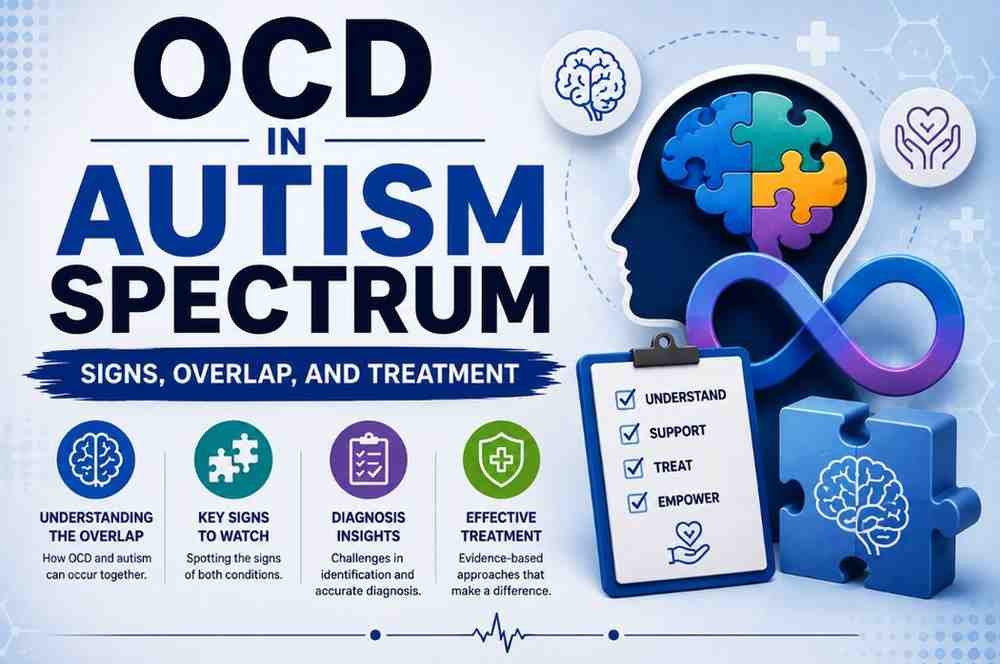
OCD in Autism Spectrum: Signs, Overlap, and Treatment
If you’ve ever watched an autistic child line up toys for the tenth time today, or noticed a loved one’s daily routine tighten into something that looks almost painful to interrupt, you may have asked yourself: is this autism, or is this OCD?
It’s a fair question, and it’s one that trips up parents, teachers, and even clinicians. Obsessive-compulsive disorder and autism spectrum disorder can look remarkably similar from the outside. Both involve repetition. Both involve a need for sameness. Both can make change feel unbearable. But underneath that surface resemblance, the two conditions work in very different ways, and they often show up together in the same person.
This guide breaks down what OCD in autism spectrum actually looks like, how common it is, why the two conditions get confused, and what actually helps.
What Is OCD, and What Is Autism?
Autism spectrum disorder (ASD) is a neurodevelopmental condition. It shapes how a person communicates, relates to others, and processes sensory information, and it typically includes restricted or repetitive patterns of behavior. Autism is present from early childhood, even if it isn’t recognized or diagnosed until later. It’s not an illness to be cured; it’s a different way the brain is wired, and traits vary widely from person to person, which is why clinicians describe autism using levels of autism based on the amount of daily support a person needs.
Obsessive-compulsive disorder (OCD) is different. It’s classified as an anxiety-related disorder marked by two core features:
- Obsessions — unwanted, intrusive thoughts, images, or urges that cause significant distress. Common themes include contamination, harm, doubt, or a need for things to feel “just right.”
- Compulsions — repetitive behaviors or mental acts (checking, counting, washing, repeating phrases) performed to reduce the anxiety the obsessions create.
OCD can develop at any age, but it most often emerges in middle childhood or adolescence, generally between ages 8 and 12. Unlike autism, OCD is not a lifelong developmental trait present from birth. Something changes, and a person who didn’t previously have intrusive, anxiety-driven rituals starts to.
Autism and OCD are separate diagnoses in the DSM-5. Autism is not a form of OCD, and OCD does not mean someone is “a little autistic.” But they can, and often do, occur in the same person.
How Common Is OCD in Autistic People?
More common than most people realize. Estimates vary across studies because of differences in how researchers define and measure symptoms, but the overall pattern is consistent: OCD shows up in autistic people far more often than it does in the general population, where OCD affects roughly 1 to 2% of adults.
A 2024 systematic review and meta-analysis pooling data from 31 studies and nearly 9,000 autistic youth found that about 11.6% also met criteria for OCD. The same analysis found that around 9.5% of children and teens diagnosed with OCD also had autism. Other clinical samples have found even higher overlap: one recent study of 603 adults with a primary OCD diagnosis found that 24.7% also had autism spectrum disorder. A broader review of anxiety in autistic youth put the OCD range as wide as 2.6% to 37.2%, depending on the sample and diagnostic tools used.
Some research also suggests the relationship runs in both directions. Autistic individuals appear to have a meaningfully higher likelihood of later receiving an OCD diagnosis, and people diagnosed with OCD first are diagnosed with autism at higher-than-expected rates later on. Interestingly, the pattern differs by sex: some meta-regression analyses have found autism is more frequently identified in samples with fewer females, hinting that OCD symptoms in autistic girls and women may be under-recognized.
Whatever the exact number, one thing researchers agree on: kids with both conditions tend to have greater functional impairment, more co-occurring mental health conditions, and more complex treatment needs than kids with either condition alone.
Why Do OCD and Autism Overlap So Often?
There’s no single explanation, but a few threads keep showing up in the research.
Shared genetic and neurobiological pathways. Both conditions run in families, and some of the same genes and brain circuits involved in cognitive flexibility, error detection, and habit formation appear to be implicated in both autism and OCD.
Difficulty tolerating uncertainty. Both autistic people and people with OCD often experience distress when situations are ambiguous or unpredictable. In autism, this frequently shows up as a need for routine and sameness. In OCD, it fuels obsessive doubt (“did I lock the door?”) and the compulsions used to resolve it.
Anxiety as a common denominator. Anxiety disorders in general are far more common in autistic people than in the general population, and OCD is classified alongside the anxiety-related conditions. A brain that’s already working harder to process sensory input and social information may be more prone to anxious thought patterns taking hold.
Sensory sensitivities. Textures, sounds, or the “wrongness” of an asymmetrical object can distress autistic people at a sensory level, and distress from unresolved sensory discomfort can look a lot like the itch to perform a compulsion, even when the underlying driver is different.
OCD vs. Autism: Telling the Repetitive Behaviors Apart
This is where most of the confusion happens, and it’s worth slowing down on because it directly affects how someone gets treated.
Autism involves what clinicians call restricted and repetitive behaviors and interests (RRBIs) — think hand-flapping, lining up objects, insisting on the same route to school, or an intense, absorbing interest in trains, weather patterns, or a favorite show. OCD involves compulsions tied to obsessions — think handwashing tied to a fear of contamination, or checking a stove tied to a fear of causing a fire.
Researchers describe the key difference using two terms: ego-syntonic and ego-dystonic.
- Autistic repetitive behaviors are usually ego-syntonic. They feel natural, comfortable, and consistent with who the person is. Stimming regulates the nervous system. Special interests bring genuine joy. Routines create predictability. An autistic person generally doesn’t want these behaviors to stop, and interrupting them causes frustration rather than fear.
- OCD compulsions are usually ego-dystonic. They feel foreign, unwanted, and driven by fear rather than comfort. The person recognizes, often painfully, that the behavior doesn’t make logical sense, but performing it feels necessary to prevent something bad from happening or to relieve unbearable anxiety. Most people with OCD wish they could stop.
A Practical Example
Picture two children lining up toy cars in a perfectly straight row.
Child A does this because it’s satisfying. It taps into a special interest in vehicles, and the repetition itself feels good. If a sibling knocks over the line, Child A gets annoyed but recovers once the row is rebuilt. This is autism.
Child B lines up the cars because of an intrusive thought that something bad will happen to a family member if the cars aren’t perfectly straight. There’s no pleasure in the activity, only relief once it’s “done right,” and that relief rarely lasts. This is OCD.
The behavior looks the same from across the room. The internal experience driving it is completely different, and that internal experience is what a clinician needs to understand to diagnose accurately.
Where It Gets Complicated
In real life, this distinction isn’t always clean cut, which is part of why co-occurring OCD in autism is so often missed or misdiagnosed.
- Some autistic people experience compulsions that also feel somewhat ego-syntonic, especially symmetry or ordering behaviors that are satisfying even when anxiety is part of the picture.
- Rigid autistic routines can trigger real distress when disrupted, not because of OCD, but simply because unpredictability is inherently harder for an autistic brain to tolerate.
- Many autistic people have both: comforting, identity-consistent routines alongside separate, anxiety-driven compulsions that develop later and layer on top of existing patterns, making the OCD symptoms harder to spot as something new.
- One of the DSM-5 requirements for an OCD diagnosis is that the person doesn’t want to engage in the behavior. But autistic individuals, particularly those with strong verbal skills, may say they’re content with a repetitive behavior even when it has features of compulsion, which can lead clinicians to under-diagnose OCD in this population.
Why OCD Gets Missed (or Misdiagnosed) in Autistic People
Several factors make accurate diagnosis genuinely difficult:
Diagnostic overshadowing. Clinicians sometimes attribute every repetitive or anxious behavior to autism itself, without asking whether a second condition has developed on top of it. This is called diagnostic overshadowing, and it’s one of the most common reasons co-occurring OCD goes untreated in autistic people for years.
Communication differences. Obsessions are internal experiences. A person needs a certain level of insight and expressive language to describe an intrusive thought clearly. Autistic individuals with limited verbal communication, or those who process and express emotion differently, may show only the outward compulsion, with no way to communicate the anxious thought driving it.
Masking and camouflaging. Some autistic individuals, especially those diagnosed later in life or those who are AFAB (assigned female at birth), learn to mask traits in social settings. This same camouflaging can obscure OCD symptoms, since a person may suppress visible compulsions in public and only reveal them at home.
Overlapping surface symptoms. Anxiety, need for control, difficulty with transitions, and social withdrawal appear in both conditions, which makes it easy to attribute new OCD symptoms to “just autism.”
Standardized tools help here. Clinicians often use the Children’s Yale-Brown Obsessive Compulsive Scale (CY-BOCS), sometimes adapted for autism, alongside a full developmental history that looks specifically for a change in symptoms over time. A sudden increase in distress, new rituals that didn’t exist before, or repetitive behavior that has clearly shifted from comforting to compulsive are all signals worth bringing to a clinician who has experience with both conditions.
Signs That Might Point to Co-Occurring OCD
Not every rigid routine is a red flag, but certain patterns are worth a closer look, especially if they represent a change from a person’s baseline:
- New rituals appear that weren’t part of the person’s routine before, particularly after a stressful event
- The behavior is accompanied by visible fear, dread, or panic rather than comfort or enjoyment
- The person expresses (verbally or through behavior) that they wish they could stop but feel unable to
- Themes center on harm, contamination, or catastrophic “what if” thinking, rather than sensory preference or special interest
- Rituals expand over time, taking up more hours of the day or pulling in family members to participate
- Reassurance-seeking increases noticeably (“Are you sure nothing bad will happen?”)
- The behavior interferes with functioning in ways that go beyond typical autism-related rigidity
Treatment Approaches for OCD in Autistic People
The encouraging news is that OCD in autistic individuals is treatable, though the approach usually needs to be adapted.
Modified CBT and Exposure and Response Prevention (ERP)
Cognitive behavioral therapy, specifically ERP, is the first-line, evidence-based treatment for OCD in the general population, and research shows it can be effective for autistic clients too when it’s modified appropriately. Standard ERP gradually exposes a person to the source of their anxiety while helping them resist the urge to perform the compulsion, allowing the anxiety to naturally decrease over repeated exposures.
For autistic clients, effective ERP programs typically include:
- More concrete, visual explanations of abstract concepts like anxiety and habituation
- Extra time built into treatment for building rapport and trust
- Involvement of caregivers or support staff to reinforce strategies outside session
- Careful attention to distinguishing which behaviors are true compulsions worth targeting versus autistic traits that shouldn’t be pathologized or extinguished
- Adjustments for sensory needs and communication style, including visual schedules and simplified language
Small studies and case reports, including work with autistic children who also have intellectual disabilities, have found that modified ERP can meaningfully reduce distress and compulsive behavior, even though most of the evidence base still comes from smaller trials rather than large randomized studies. Clinicians experienced in both autism and OCD generally agree the therapy works, it just needs a more individualized delivery.
Medication
Selective serotonin reuptake inhibitors (SSRIs) are the most commonly prescribed medications for OCD and are sometimes used alongside therapy for autistic individuals with OCD. However, some research suggests autistic patients may be more sensitive to side effects from these medications, and antipsychotic medications are prescribed considerably more often in this population than in OCD patients without autism. Medication decisions should always involve a psychiatrist familiar with both conditions, since dosing and monitoring often need to be more conservative.
Family and Caregiver Involvement
Because compulsions can pull family members into participating (repeating reassurances, performing rituals alongside the child, avoiding certain triggers to keep the peace), family-based treatment is often a core part of effective care. Caregivers learn how to respond supportively without accidentally reinforcing the compulsive cycle.
Common Mistakes to Avoid
Treating every repetitive behavior as something to eliminate. Not all repetition needs to be treated. Ego-syntonic autistic traits like stimming or special interests are healthy self-regulation and shouldn’t be targeted by therapy meant for OCD.
Assuming a verbal autistic person would “just say” if something was OCD. Insight into one’s own compulsions can be genuinely difficult, autistic or not. Absence of a verbal complaint doesn’t rule out OCD.
Using unmodified, generic ERP protocols. A one-size-fits-all approach designed for neurotypical clients may not translate well without adjustments for communication style, sensory needs, and pacing.
Waiting too long to seek a second opinion. If a treatment plan built around “just autism” isn’t reducing distress, it’s worth consulting a clinician with specific experience in co-occurring OCD and autism, since general autism support alone won’t address obsessive-compulsive symptoms.
Overlooking the person’s own account of the behavior. Whenever possible, ask directly: does this feel good, neutral, or does it feel like something you have to do to stop something bad from happening? The answer often points straight to the right diagnosis.
Frequently Asked Questions
Is OCD part of the autism spectrum? No. OCD and autism are separate diagnoses with different criteria in the DSM-5. Autism is a neurodevelopmental condition present from early childhood, while OCD is an anxiety-related disorder that can develop at any age. They frequently co-occur, but having one does not mean a person has the other.
Can autistic people be diagnosed with OCD? Yes. Research shows roughly 1 in 10 autistic children and teens also meet criteria for OCD, and some clinical samples report even higher rates in adults. A qualified mental health professional experienced in both conditions can assess for co-occurring OCD using structured tools like the CY-BOCS alongside a detailed history.
How do you tell the difference between autism stimming and OCD compulsions? The clearest distinction is the internal experience. Stimming and other autistic repetitive behaviors are usually ego-syntonic, meaning they feel comfortable, self-soothing, or enjoyable. OCD compulsions are usually ego-dystonic, meaning they feel driven by fear and are performed to relieve anxiety rather than for enjoyment. Looking at whether a behavior brings comfort or relief from dread is often more useful than looking at the behavior itself.
What age does OCD typically start in autistic children? OCD symptoms generally emerge between ages 8 and 12, though they can appear earlier or later. This is notably different from autism, which is present from early development, so new rigid or anxious behaviors that appear well after early childhood are worth evaluating for possible OCD.
Does ERP work for autistic people with OCD? Yes, when it’s modified appropriately. Research and clinical case reports show that exposure and response prevention can meaningfully reduce OCD symptoms in autistic children and adults, particularly when therapists adjust for communication style, sensory sensitivities, and pacing, and involve caregivers in reinforcing strategies at home.
Can autism traits be mistaken for OCD, or the other way around? Both happen. Diagnostic overshadowing, where every symptom gets attributed to autism, can cause OCD to go unrecognized for years. Conversely, an autistic person’s comforting routines can sometimes be misread as compulsions by clinicians unfamiliar with autism, leading to unnecessary treatment targeting behaviors that aren’t actually harmful.
The Bottom Line
OCD and autism can look alike on the surface, but they come from different places. Autism’s repetitive behaviors tend to bring comfort and meaning; OCD’s compulsions are driven by fear and offer only temporary, uneasy relief. When both conditions show up in the same person, and research suggests that happens far more often than chance would predict, getting an accurate diagnosis matters enormously. It’s the difference between therapy that respects who someone is and therapy that actually addresses what’s causing them distress.
If you notice new, fear-driven rituals in yourself or someone you care about, especially ones that feel different from long-standing autism traits, it’s worth talking to a clinician who understands both conditions. And if you’re still working out where a person’s traits fall across the spectrum more broadly, understanding the different levels of autism can also help put day-to-day behaviors, including repetitive ones, into clearer context, whether you’re looking at level one autism specifically or trying to understand how many levels of autism are there in the diagnostic criteria overall.