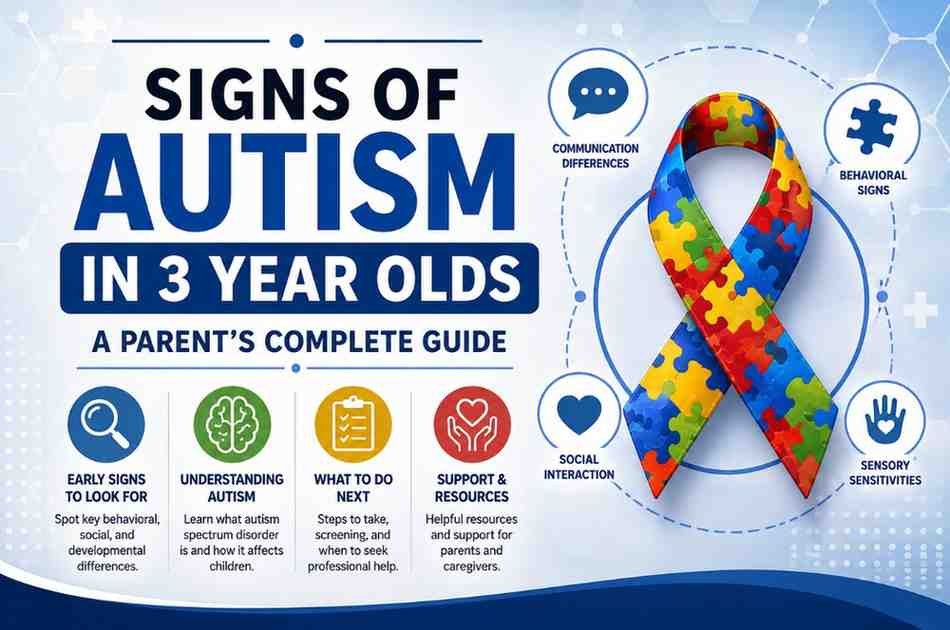
Signs of Autism in 3 Year Olds: A Parent’s Complete Guide
Three is an age of big changes. Sentences get longer, pretend play gets more elaborate, and kids start negotiating with you like tiny lawyers. So when a 3-year-old isn’t hitting those marks, it’s natural for a parent to wonder what’s going on.
If you’re here, you’ve probably already noticed something. Maybe your child doesn’t answer to their name the way your friend’s kid does. Maybe playdates feel harder than they should. That instinct is worth listening to. Parents are usually the first to notice developmental differences, often well before a doctor does.
This guide walks through the signs of autism in 3 year olds in plain language, explains how autism can look different in boys and girls, and lays out exactly what to do next if something feels off. It also touches on a question many parents ask once they start reading about autism spectrum disorder: whether the different types of autism matter for what you’re seeing at home, and whether the condition shows up in other species too — something researchers exploring whether animals can have autism have looked into as well.
What Autism Spectrum Disorder Actually Is
Autism spectrum disorder, or ASD, is a developmental condition that affects how a person communicates, interacts socially, and processes the world around them. It’s called a “spectrum” because it looks different in every child — some 3-year-olds with autism are nonverbal, others talk in full paragraphs about their favorite topic but struggle with back-and-forth conversation.
The Centers for Disease Control and Prevention tracks autism prevalence across the country, and the numbers have climbed steadily as awareness and screening have improved. Recent CDC surveillance data puts the rate at roughly 1 in 31 eight-year-old children in the United States identified with ASD, a jump from earlier estimates that reflects better detection rather than a sudden surge in cases.
Autism is also diagnosed far more often in boys than girls, with the male-to-female ratio landing somewhere around 3 to 4.5 boys diagnosed for every girl. That gap gets narrower once researchers actively screen entire populations instead of relying on referrals, which suggests a real number of autistic girls are being missed. We’ll come back to why.
Why Age 3 Is a Turning Point for Spotting Signs
Autism can sometimes be identified before a child’s first birthday, and screening tools are designed to catch early warning signs as young as 18 months. But three is when things often become unmistakable. Preschool, social groups, and structured play all raise the bar for the skills a child is expected to show — sharing, taking turns, following two-step directions, playing pretend with other kids. When a child can’t meet those expectations, the gap between them and their peers becomes much easier to see.
It’s also worth knowing that roughly a third of children later diagnosed with autism seem to develop typically through their first 18 months and then plateau or regress. That’s one reason the American Academy of Pediatrics recommends more than one screening visit rather than a single check early on.
Core Signs of Autism in a 3-Year-Old
Doctors group autism symptoms into a few main categories: social communication, repetitive behaviors, and sensory processing. No single behavior on this list means your child is autistic — it’s the pattern, and how many areas are affected, that matters.
Social Communication Differences
- Doesn’t respond consistently when called by name
- Rarely makes eye contact, or eye contact feels fleeting and effortful
- Doesn’t point to show you something interesting (“look, a dog!”)
- Struggles to follow another person’s gaze or pointing finger
- Prefers to play alone rather than with other children
- Doesn’t imitate others’ actions or facial expressions
- Has little interest in showing affection or being held
- Doesn’t engage in back-and-forth “conversation,” even with limited words
- Shows little interest in other children, or doesn’t know how to approach them
Speech and Language Delays
- Has fewer than 50 words, or hasn’t started combining words into short phrases by age 3
- Loses words or skills they previously had (regression)
- Repeats words or phrases out of context (echolalia) without using them to communicate
- Talks “at” people rather than with them, especially about a narrow topic of interest
- Uses odd tone, rhythm, or pitch when speaking
- Doesn’t use gestures like waving or shaking their head to communicate
Repetitive Behaviors and Routines
- Lines up toys or objects instead of playing with them as intended
- Flaps hands, rocks, spins, or toe-walks
- Becomes very upset over small changes to routine
- Fixates intensely on specific objects, topics, or parts of objects (like wheels spinning)
- Shows limited or absent pretend play — for example, doesn’t pretend to feed a doll or cook
Sensory Differences
- Overreacts or underreacts to sounds, textures, lights, or smells
- Avoids certain food textures or has an unusually limited diet
- Seeks out intense sensory input, like spinning or crashing into things
- Seems not to notice pain or temperature the way other children do
- Covers ears at ordinary noises, or seems unbothered by loud sounds that startle others
A child doesn’t need every item on this list to be autistic, and having one or two traits doesn’t mean autism either. What clinicians look for is consistency across multiple areas and settings — at home, at daycare, with grandparents — not just a single bad day.
Signs of Autism in a 3 Year Old Boy
Boys are diagnosed with autism more often than girls, and their presentation tends to match the “classic” profile most screening tools were originally built around. In a 3-year-old boy, autism often shows up as:
- Noticeable speech delay compared to same-age peers
- Repetitive physical behaviors like hand flapping or spinning objects
- Strong, narrow interests — a fascination with trains, fans, or numbers, for example
- Difficulty joining group play at daycare or preschool
- Meltdowns tied to sensory overload or disrupted routines
Because this pattern is well documented and highly visible, boys are typically identified earlier than girls with a similar level of need.
Signs of Autism in a 3 Year Old Girl
Autism in girls doesn’t always look the same, which is a major reason girls are diagnosed later on average — and sometimes not until adolescence or adulthood. Girls with autism often develop stronger compensatory social skills early on. They may watch peers closely and copy social behavior, a pattern researchers call camouflaging or masking. A 2018 study from the Center for Autism Spectrum Disorders at Children’s National found that girls with autism may show symptoms differently than boys, and some of their social difficulties can be masked during clinical assessment, even though those same girls often struggle more with daily living skills at home than their outward behavior suggests.
In a 3-year-old girl, autism may show up as:
- Interests that look typical on the surface — animals, dolls, or fictional characters — but are pursued with unusual intensity or rigidity
- Staying near a peer group without truly joining in, rather than withdrawing completely
- Meltdowns or anxiety that appear mainly at home, after a day of “holding it together” elsewhere
- Subtle language differences, like scripted phrases borrowed from books or shows
- Selective mutism or unusual quietness in unfamiliar settings
Because these signs are easier to miss, it’s worth trusting your gut if a daughter seems “fine” at preschool but consistently struggles, melts down, or seems exhausted at home. Parents and caregivers often notice these differences long before a screening tool does.
What’s Typical Behavior vs. What’s Worth Watching
Every 3-year-old has quirks. Shyness, a picky palate, an intense love of dinosaurs — none of that is automatically a red flag. The difference usually comes down to degree and impact.
Typical: A shy child warms up after a few minutes with new people and still makes eye contact with familiar caregivers. Worth watching: A child rarely makes eye contact even with parents, and doesn’t seem to notice when someone enters or leaves the room.
Typical: A picky eater who refuses vegetables but eats a decent variety otherwise. Worth watching: A child who will only eat five foods total and gags or panics at new textures.
Typical: A tantrum when a favorite toy is taken away. Worth watching: Extreme distress over minor changes, like a different route to daycare or a rearranged bookshelf.
If you’re weighing your child’s behavior against these examples and still unsure, that uncertainty alone is a good enough reason to talk to your pediatrician.
How Autism Is Diagnosed at This Age
There’s no blood test or brain scan for autism. Diagnosis relies on trained observation and structured assessment, usually done in a few steps.
- Developmental screening. Pediatricians typically use the M-CHAT-R (Modified Checklist for Autism in Toddlers, Revised), a 20-question caregiver survey. The American Academy of Pediatrics recommends autism-specific screening at both the 18- and 24-month well-child visit, though it can be used with any child between 16 and 30 months.
- Follow-up interview. A positive screen leads to a short follow-up conversation with the provider to clarify specific answers.
- Referral for full evaluation. If concerns remain, your child is referred to a developmental pediatrician, child psychologist, or multidisciplinary team for comprehensive testing, which usually includes direct observation, parent interviews, and standardized tools like the ADOS-2.
- Hearing and vision checks. These are usually done alongside the evaluation to rule out other explanations for delayed speech or reduced eye contact.
A positive screening result is not a diagnosis. It simply means further evaluation is worthwhile. Many children who screen positive turn out to have a different developmental difference, or no diagnosis at all.
It’s worth knowing that the average age of autism diagnosis in the U.S. still trails the recommended screening timeline by a wide margin — only about half of children are diagnosed by age 3, even though reliable screening can begin well before then. If you have concerns now, don’t wait for a scheduled well-child visit to raise them.
Common Mistakes Parents Make
Waiting for someone else to say something first. Many parents notice differences months or years before a teacher or doctor raises the topic. Trust your observations and bring them up directly.
Comparing to only one other child. Development varies a lot between individual kids. Compare your child’s progress to established milestones, not just to a cousin or neighbor.
Assuming a verbal child can’t be autistic. Plenty of autistic children speak in full sentences. The issue is often how language is used socially, not whether words exist at all.
Treating a single sign as proof. One repetitive behavior or one late milestone rarely tells the whole story. Evaluators look at the full pattern across settings.
Delaying evaluation out of fear. An evaluation doesn’t lock your child into a label overnight, and early intervention services can often start even while a formal diagnosis is pending in many states.
What to Do If You Notice These Signs
- Write down specific examples. Instead of “he doesn’t listen,” note things like “doesn’t turn around when called by name from across the room, even when not distracted.”
- Talk to your pediatrician soon. You don’t need to wait for a scheduled checkup. Call and describe what you’re seeing.
- Ask for a formal screening if one hasn’t been done. You can also complete an M-CHAT-R yourself online and bring the results to your appointment.
- Request a referral to Early Intervention. In the U.S., children under 3 can access free evaluation and services through their state’s Early Intervention program, regardless of formal diagnosis status. After age 3, this shifts to your local school district.
- Consider a developmental pediatrician or psychologist. These specialists conduct the in-depth evaluations needed for an official diagnosis.
Early intervention is one of the most consistent findings in autism research: children who start speech, occupational, or behavioral therapy earlier tend to make stronger gains in communication and social skills. That’s true whether or not your child ultimately receives an autism diagnosis — the underlying support helps regardless. It’s also worth understanding that autism itself isn’t a single condition; the different types of autism recognized under the broader spectrum can call for different combinations of support, which is part of why a thorough evaluation matters more than a quick label.
Frequently Asked Questions
Can a 3-year-old be too young for an autism diagnosis? No. Autism can be reliably diagnosed by experienced clinicians as early as 18 to 24 months, and many children are formally diagnosed around age 2 or 3. Three is well within the typical window for a confident diagnosis.
Do all autistic 3-year-olds have a speech delay? No. Some autistic children are highly verbal at this age but show differences in how they use language socially — for example, talking extensively about one topic without noticing whether the listener is interested.
Is hand flapping always a sign of autism? Not necessarily. Many neurotypical toddlers flap their hands or engage in other repetitive movements, especially when excited. It becomes more notable when it’s frequent, persists well past toddlerhood, or appears alongside other social and communication differences.
Are girls really less likely to be autistic, or just less likely to be diagnosed? Both factors play a role. Boys are diagnosed more often, but a growing body of research suggests girls are under-identified because they present differently and often mask their traits more effectively, especially in clinical settings.
What’s the difference between autism and a speech delay alone? A pure speech delay usually doesn’t affect eye contact, social interest, or play skills. A child with a speech delay alone typically still points, makes eye contact, and enjoys interacting with others — they simply have fewer words to do it with.
Should I wait to see if my child “grows out of it”? It’s reasonable to monitor mild concerns for a short period, but persistent signs across multiple settings shouldn’t be left unaddressed. Screening is quick, free through most pediatricians, and causes no harm if the results turn out reassuring.
Can autism be caused by vaccines? No. This claim has been thoroughly studied and repeatedly disproven by large-scale research. Autism has genetic and neurological roots that begin developing before birth.
The Bottom Line
Recognizing the signs of autism in 3 year olds isn’t about diagnosing your own child from a list on the internet. It’s about knowing what to watch for so you can start a conversation with your pediatrician sooner rather than later. Whether your child is a boy or girl, verbal or not, the earlier a potential concern gets evaluated, the earlier your family can access support that actually helps — and that timing matters far more than getting a label exactly right on day one.