How Many Levels of Autism Are There? Understanding ASD Levels 1, 2, and 3
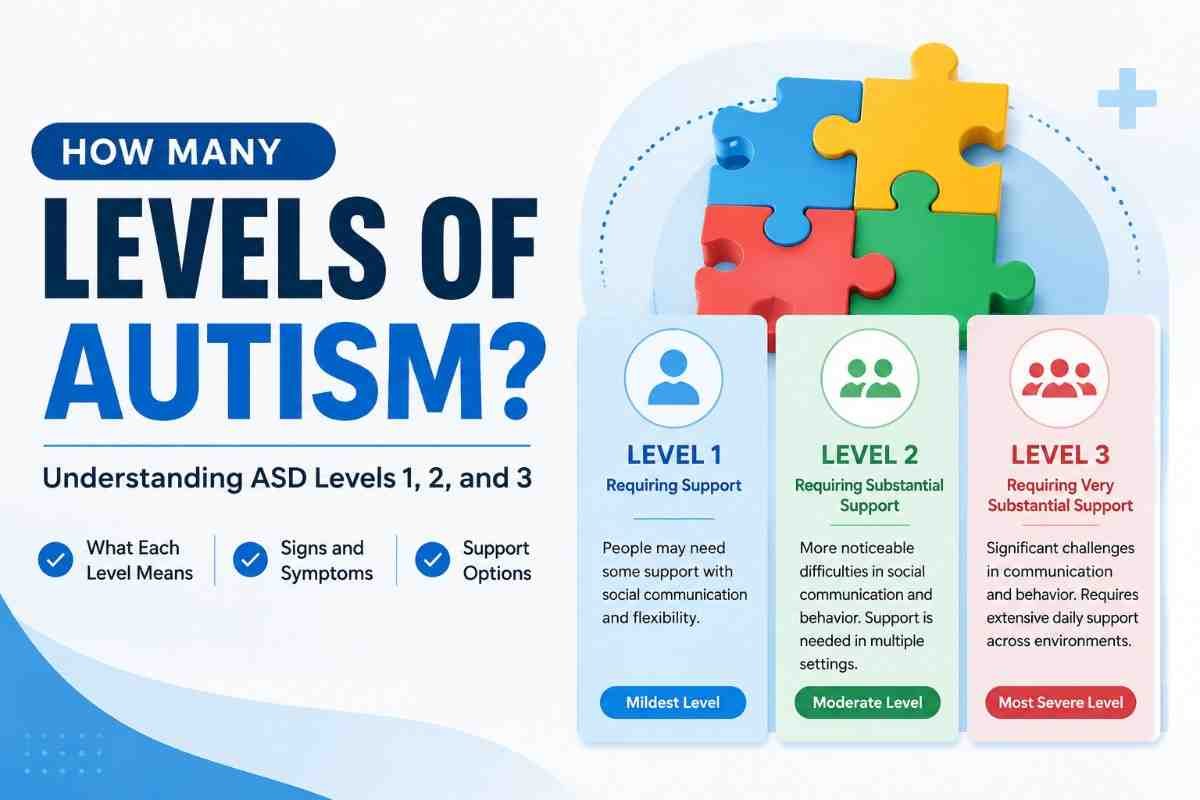
If you have recently received an autism diagnosis for yourself or a child, or you are trying to make sense of a report full of clinical language, one question tends to come up right away: how many levels of autism are there? The short answer is three. Since 2013, the Diagnostic and Statistical Manual of Mental Disorders, Fifth Edition (DSM-5), has recognized autism spectrum disorder as a single diagnosis with three severity levels, based primarily on how much daily support a person needs.
That answer, though, only scratches the surface. Knowing that there are three levels of autism does not tell you what separates one level from another, how clinicians actually assign a level, or why the system has drawn criticism from parts of the autism community. This guide walks through all of it, using the current diagnostic framework used across the United States, so you leave with a genuinely complete picture rather than a one-line definition.
What Does “Levels of Autism” Actually Mean?
Before the DSM-5, autism was not treated as a single diagnosis. The fourth edition of the manual, DSM-IV, split it into several separate conditions: Autistic Disorder, Asperger’s Syndrome, Pervasive Developmental Disorder Not Otherwise Specified (PDD-NOS), and Childhood Disintegrative Disorder. Someone could be diagnosed with one of these labels depending on their language development, cognitive profile, and the age symptoms first appeared.
The American Psychiatric Association folded all of these into one category, autism spectrum disorder, when it published the DSM-5 in 2013. Rather than sorting people into separate diagnoses, clinicians now assign a severity level that reflects the support a person requires in two core domains:
- Social communication and social interaction
- Restricted, repetitive patterns of behavior, interests, or activities
A person’s level is not a measure of intelligence, personality, or long-term potential. It is a clinical snapshot of support needs at the time of evaluation, and it can look different from one person to the next even within the same level, because autism itself is highly individual.
The Three DSM-5 Autism Levels Explained
So when someone asks how many levels of autism are there according to current diagnostic standards, the answer is always the same three categories, numbered by the intensity of support a person is likely to need.
Level 1 Autism: Requiring Support
Level 1 is the mildest of the three levels of autism. People at this level can usually communicate in full sentences and engage in conversation, but they often struggle with the back and forth nature of social interaction, reading nonverbal cues, or initiating contact with others. Without support, these social difficulties can make it hard to form friendships or navigate group settings such as school or work.
Rigid thinking, difficulty switching between tasks, and challenges with organization and planning are also common at this level. Many adults who were diagnosed later in life, or who were previously described using the outdated term “high functioning,” fall into this category. You can read a more detailed breakdown of traits, diagnostic criteria, and daily life at level one autism, including how it differs from the other two levels in practice.
Level 2 Autism: Requiring Substantial Support
Level 2 autism involves more noticeable deficits in both verbal and nonverbal social communication. Even with support in place, social impairments tend to be obvious to others, and the person may use shorter sentences, have a narrower range of interests, or rely heavily on routine to feel regulated.
Restricted and repetitive behaviors are usually frequent enough to be apparent to a casual observer and can interfere with functioning across more than one setting. Coping with unexpected change is often significantly harder at this level than at Level 1, and support is typically needed throughout the day rather than only in specific situations.
Level 3 Autism: Requiring Very Substantial Support
Level 3 represents the most significant support needs among the three levels of autism. Social communication is severely limited, verbal language may be minimal or absent, and initiating interaction with others rarely happens without direct prompting. Repetitive behaviors, intense fixations, or resistance to change tend to interfere markedly with functioning across nearly every environment.
People with Level 3 autism generally require extensive, ongoing support with daily living, safety, and communication. Some individuals use alternative and augmentative communication tools, such as picture exchange systems or speech-generating devices, rather than spoken language.
How Clinicians Determine an Autism Level
There is no blood test, brain scan, or single questionnaire that produces an autism level automatically. A level is assigned after a comprehensive evaluation, usually conducted by a psychologist, developmental pediatrician, psychiatrist, or a multidisciplinary team trained in autism assessment.
That evaluation typically draws on several sources of information:
- Direct observation of the individual, often using structured tools such as the Autism Diagnostic Observation Schedule (ADOS-2)
- Detailed developmental history, frequently gathered through the Autism Diagnostic Interview-Revised (ADI-R) or similar caregiver interviews
- Reports from parents, teachers, or other caregivers describing behavior across different settings
- Cognitive and language testing, when relevant, to understand the person’s broader developmental profile
Because level is tied to functional support needs rather than a fixed trait, the same evaluator may describe a person’s needs differently across the two domains. It is entirely possible, for example, for someone to show Level 2 traits in social communication while presenting closer to Level 1 in restricted or repetitive behavior. In those cases, clinicians usually note both domains rather than forcing a single number.
Autism Levels vs. Functioning Labels
Before the levels system existed, it was common to hear autism described informally as “high functioning” or “low functioning.” Many clinicians and autistic self-advocates have moved away from this language, and it is worth understanding why, since you will still encounter these terms in older articles and everyday conversation.
Functioning labels tend to flatten a person’s experience into a single word that does not capture how support needs vary by domain, by day, or by environment. Someone labeled “high functioning” might have strong verbal skills but struggle intensely with sensory regulation or executive function, while someone labeled “low functioning” might have significant communication challenges alongside strong nonverbal reasoning abilities. The DSM-5 levels attempt to be more precise by separating social communication from repetitive behavior and by framing everything around support needs rather than a vague sense of severity.
That said, the levels system is not without its own limitations. Critics point out that a single number still cannot capture the full complexity of autism, that levels can be assigned inconsistently between evaluators, and that support needs described at diagnosis do not always predict how a person will function years later, particularly with intervention, environmental changes, or increasing age.
Can an Autism Level Change Over Time?
Yes, and this is one of the more misunderstood aspects of the diagnostic system. A level reflects support needs at the time of assessment, not a permanent classification. With early intervention, therapy, changes in environment, or simply development over time, a person’s presentation can shift, and a later evaluation might describe different support needs than an earlier one.
It also works the other way. Support needs can become more apparent during major life transitions, such as starting school, entering puberty, or moving into an unstructured work environment, even without any change in the underlying condition. This is one reason clinicians generally recommend viewing an autism level as a snapshot rather than a lifelong label.
How the DSM-5 Compares to Other Classification Systems
The DSM-5 is the primary diagnostic manual used across the United States, but it is not the only system in use worldwide. The World Health Organization’s International Classification of Diseases, 11th Revision (ICD-11), also recognizes autism spectrum disorder and centers the diagnosis on the same two core areas, social communication difficulties and restricted, repetitive behavior patterns. However, ICD-11 does not use the same three-tier severity specifier found in the DSM-5. Instead, it considers support needs, including whether the person has a co-occurring intellectual disability or impaired functional language, without assigning a numbered level in the same way.
This distinction matters mainly for clinicians working internationally or for families navigating diagnoses made outside the United States, since a level assigned under DSM-5 criteria does not have a precise one-to-one equivalent under ICD-11.
Autism Levels and Co-Occurring Conditions
Autism rarely exists in isolation. Many people on the spectrum, regardless of their assigned level, also experience one or more co-occurring conditions that affect daily functioning and can complicate the diagnostic picture. Common overlaps include anxiety disorders, sleep difficulties, sensory processing differences, epilepsy, and intellectual disability, particularly at Level 2 and Level 3.
One of the most frequently discussed overlaps is with Attention-Deficit/Hyperactivity Disorder. For years, clinicians were discouraged from diagnosing both conditions in the same person, but current diagnostic guidance allows for a combined diagnosis when criteria for both are met. Understanding how the two conditions interact, and how clinicians tell them apart during an evaluation, is covered in more depth in this guide to ADHD and Autism Diagnosis, which is a useful next read if inattention, impulsivity, or hyperactivity are also part of the picture.
Getting an Evaluation and Building a Support Plan
If you suspect that you or your child may be on the autism spectrum, the starting point is a referral to a qualified evaluator, typically through a pediatrician, primary care provider, or school psychologist. A full evaluation takes time, often several hours across multiple sessions, and should include direct observation, caregiver interviews, and standardized testing rather than a brief conversation alone.
Once a diagnosis and level are established, the real value lies in what happens next. A level can guide conversations about services such as speech therapy, occupational therapy, applied behavior analysis, social skills training, or educational accommodations under an Individualized Education Program. The number itself is far less important than the individualized plan built around it.
Frequently Asked Questions
Is there a level 4 autism?
No. The DSM-5 recognizes only three levels of autism spectrum disorder: Level 1, Level 2, and Level 3. There is no official Level 4 or higher classification in current diagnostic guidelines.
What was level 1 autism previously called?
Level 1 autism is often associated with what used to be informally called “high functioning autism” or, before the DSM-5, with a separate diagnosis known as Asperger’s Syndrome. Neither term is used in current clinical diagnosis.
Can a person’s autism level change after diagnosis?
Yes. A level reflects support needs at the time of evaluation rather than a fixed, lifelong trait. With therapy, development, or changes in environment, a later assessment may describe different support needs than an earlier one.
Is an autism level based on IQ or intelligence?
No. Autism levels are based on the amount of support a person needs for social communication and for managing restricted or repetitive behaviors. Intellectual ability is assessed separately and is not what determines the level itself.
What is the difference between autism levels and autism types?
Autism levels describe severity and support needs within a single diagnosis under the DSM-5. Older systems, such as DSM-IV, used separate diagnostic types, including Autistic Disorder, Asperger’s Syndrome, and PDD-NOS, which have since been combined into one diagnosis, autism spectrum disorder, with levels used to indicate severity.
Final Thoughts
So, how many levels of autism are there? Three, under the current DSM-5 framework used throughout the United States: Level 1, requiring support; Level 2, requiring substantial support; and Level 3, requiring very substantial support. These levels exist to help clinicians, families, and educators plan appropriate services, not to sum up a person’s identity or potential in a single digit.
If you are navigating a new diagnosis, the most useful next step is usually a conversation with the evaluating clinician about what the assigned level means in practical terms, what supports are recommended, and how progress will be reassessed over time. Autism is a spectrum in the truest sense, and understanding where someone falls on it is only the beginning of building the right plan around them.