ocd vs autism
When a child lines up objects with perfect precision, or an adult cannot leave the house without following a rigid sequence of steps, the behavior itself tells you very little. What matters — clinically, therapeutically, and for the person experiencing it — is the reason behind it. That is precisely why the comparison of OCD vs autism comes up so frequently in clinical settings, in parenting communities, and in conversations among adults who are still trying to understand their own minds.
Obsessive-Compulsive Disorder and Autism Spectrum Disorder are genuinely distinct conditions with different neurological origins, different diagnostic criteria, and importantly, different treatment approaches. Yet they share enough surface-level features that they are routinely confused with each other, and in some cases, one is diagnosed when both are actually present. Understanding where they overlap, where they diverge, and what happens when they co-occur is essential for anyone navigating either diagnosis.
What Is OCD?
Obsessive-Compulsive Disorder is classified as an anxiety-related disorder characterized by two core features: obsessions and compulsions. Obsessions are unwanted, intrusive thoughts, images, or impulses that generate significant distress. They are ego-dystonic, meaning the person experiencing them typically recognizes that these thoughts feel foreign, frightening, or contrary to their values. Common obsessions include fears of contamination, fears of causing harm to others, fears that something terrible will happen if a specific action is not performed, and persistent doubts about whether an action was completed correctly.
Compulsions are the behavioral responses to those obsessions. They are repeated actions or mental rituals performed specifically to reduce the anxiety generated by the intrusive thought. Checking a lock five times, washing hands until the skin is raw, or repeating a phrase silently to ward off a feared outcome are all examples of compulsions. The person generally knows the action is excessive or irrational, yet the anxiety relief it provides reinforces the cycle. According to diagnostic criteria, OCD is clinically significant when obsessions and compulsions consume more than one hour per day and meaningfully interfere with daily functioning.
OCD can develop at any point in life. It is not a neurodevelopmental condition rooted in early brain development, which is one of the fundamental distinctions between it and autism.
What Is Autism Spectrum Disorder?
Autism Spectrum Disorder is a neurodevelopmental condition present from birth, shaped by differences in brain structure and connectivity that affect how a person processes sensory information, communicates, and relates to the social world. It is lifelong, and while its expression varies enormously from person to person, two core domains of difference are consistent across the spectrum: social communication and interaction, and restricted or repetitive patterns of behavior and interests.
Those restricted and repetitive behaviors are where the confusion with OCD most often begins. Autistic individuals frequently engage in what are called stimming behaviors, which include rocking, hand-flapping, repeating sounds or phrases, or lining up objects. They often have highly specific routines they follow each day and may experience significant distress when those routines are disrupted. They frequently develop intense, focused special interests that consume much of their attention and emotional energy.
To learn more about how autism presents differently across individuals, including how historical subcategories like Asperger syndrome relate to the modern spectrum model, the article on autism vs Asperger’s syndrome provides useful context for understanding the full picture of autistic neurodivergence.
OCD vs Autism: Where the Real Confusion Lies
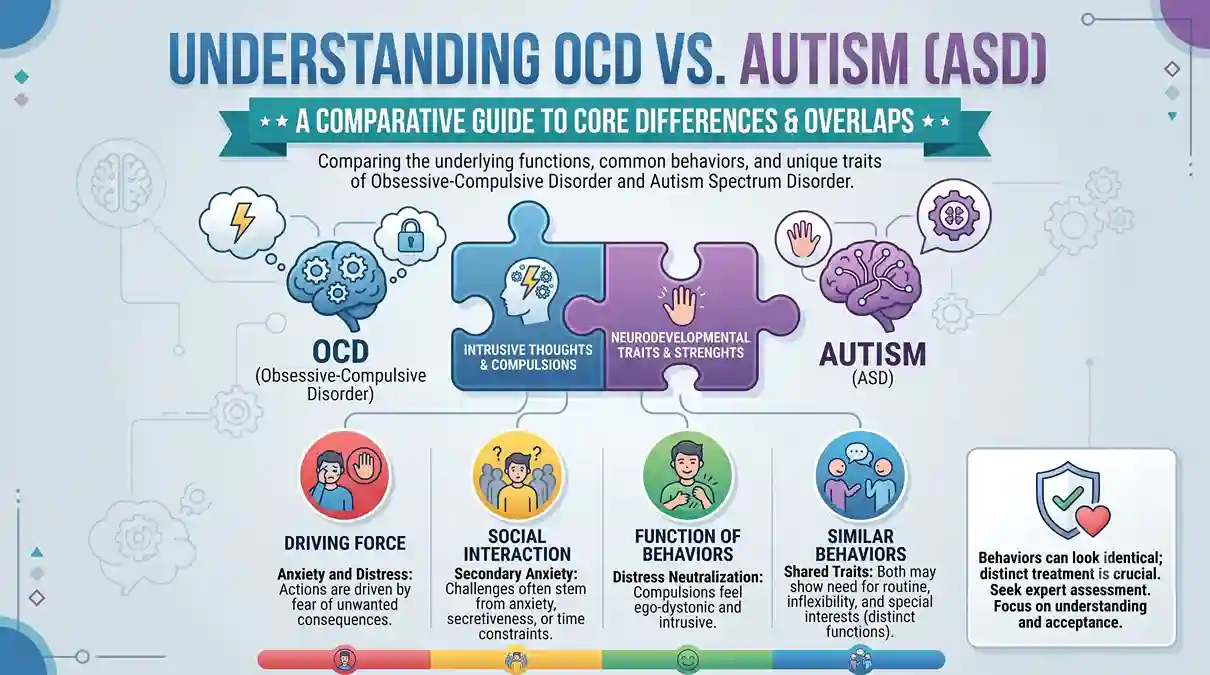
On the surface, repetitive behaviors look the same regardless of whether they originate from autism or OCD. A child who must complete a bedtime routine in exactly the same order every single night, or an adult who becomes intensely distressed when furniture is moved, could be described by either framework.
The critical question clinicians are trained to ask is not what the behavior looks like but why it is happening and how it feels from the inside.
Ego-Syntonic vs Ego-Dystonic: The Internal Experience
This distinction is arguably the most clinically useful point of separation between the two conditions.
Autistic repetitive behaviors are typically ego-syntonic. That means they feel natural, comfortable, and often genuinely pleasurable to the person. An autistic child who lines up toys experiences something satisfying and regulating in that activity. It is an extension of who they are, not something imposed on them by fear. Disrupting it causes distress, but that distress is rooted in having a preferred sensory or organizational experience interrupted, not in anxiety about a catastrophic outcome.
OCD compulsions are typically ego-dystonic. The person performing them generally wishes they did not have to. The compulsion is not something they enjoy; it is a desperate response to an internal alarm system that will not stop ringing until the ritual is performed. A person with OCD who lines up objects may be doing so because a terrifying thought has convinced them that if the items are not perfectly aligned, something terrible will happen. The relief is temporary, and the cycle begins again.
Routines: Comfort vs Anxiety Management
Both autistic people and those with OCD tend to rely heavily on routine and structure. But the function of that structure differs.
For autistic individuals, routines provide a reliable, predictable environment in what can feel like an unpredictable and overwhelming sensory world. The routine is organizing and calming in itself. Changes in routine are distressing because they remove that sense of reliable structure, not because the person fears a specific negative consequence.
For someone with OCD, routines are often constructed specifically to manage anxiety and prevent feared outcomes. They are not inherently comforting; they are instrumental. The person may recognize that the routine makes no logical sense and may feel exhausted or embarrassed by it, but the anxiety it temporarily suppresses keeps them locked in the pattern.
Special Interests vs Obsessions
Autistic individuals frequently develop what are called special interests: areas of deep, passionate focus that can span years or decades. These interests bring genuine joy, connection, and a sense of mastery. They are not distressing in the way OCD obsessions are.
OCD obsessions, by contrast, are not interests at all. They are intrusive and unwanted. They typically revolve around fear rather than fascination, and the person experiencing them would, in most cases, strongly prefer not to be having them.
When Both Are Present: OCD and Autism Co-Occurring
The relationship between OCD and autism becomes even more complex when both conditions are present simultaneously, which happens with significant frequency. Research estimates that somewhere between 17 and 37 percent of autistic individuals also meet the criteria for OCD, a rate substantially higher than in the general population. This co-occurrence creates a diagnostic and therapeutic challenge that requires careful, experienced clinical assessment.
A useful way to identify OCD in an autistic person is to look for a shift in the character of their behaviors. If a routine or repetitive behavior that previously felt calming and regulatory has transformed into something that feels urgent, desperate, or accompanied by intrusive thoughts about harm or catastrophe, this may signal OCD emerging alongside existing autistic traits. Another indicator is the concept clinicians sometimes call the “doubting disease”: the person knows they completed an action, but the thought loops back relentlessly demanding they check again. This quality of persistent, anxiety-driven doubt is characteristic of OCD rather than autism.
To read more specifically about how OCD presents within the context of autism, including the diagnostic nuances and evidence-based frameworks for understanding the relationship, the dedicated resource on OCD in the autism spectrum explores this overlap in greater detail.
A Side-by-Side Comparison
The following comparison is designed to support understanding, not to replace professional evaluation. Real presentations are often more complex than any table can capture.
| Feature | Autism (Repetitive Behaviors) | OCD (Compulsions) |
|---|---|---|
| Nature of condition | Neurodevelopmental | Anxiety-related disorder |
| Present from | Birth | Can develop at any age |
| Primary driver | Sensory regulation, comfort, identity | Anxiety relief, preventing feared outcomes |
| Internal experience | Ego-syntonic: feels natural, calming | Ego-dystonic: feels unwanted, distressing |
| Thought content | Special interests, sensory focus | Intrusive, fearful, distressing thoughts |
| Response to disruption | Frustration, sensory distress | Intense anxiety, fear of catastrophic outcome |
| Insight | Variable; behavior feels like “self” | Often aware the thought or behavior is irrational |
Why Accurate Diagnosis Is Not Optional
Confusing OCD with autism, or missing one when both are present, does not simply affect a label. It directly determines the treatment path, and the wrong path can cause real harm.
Exposure and Response Prevention therapy, known as ERP, is the gold-standard evidence-based treatment for OCD. It involves deliberately confronting anxiety-provoking situations without performing the compulsive response, gradually reducing the power of the obsession over time. For someone whose repetitive behaviors are actually autistic self-regulation strategies, applying ERP logic is not only ineffective but potentially harmful. Attempting to prevent stimming or impose change on necessary regulatory behaviors can increase anxiety and erode trust in the therapeutic relationship.
Conversely, if genuine OCD is present in an autistic person and is misattributed entirely to autism, the person may never receive the specific intervention that could meaningfully reduce their distress. Standard autism-focused support does not address the intrusive thought cycle that defines OCD.
When both conditions are confirmed, treatment requires an adapted approach. ERP can be modified for autistic individuals by introducing visual supports, slower pacing, more structured hierarchies, and careful separation of OCD-driven anxiety from sensory-related distress. Medication in the form of SSRIs is sometimes used as an adjunct, though its effectiveness varies more in autistic populations than in the general population, and children in particular may require careful monitoring for side effects. The National Institute of Mental Health provides an overview of OCD treatments and the evidence base behind them.
The Challenge of Diagnosis: Why It Gets Missed
Several factors consistently contribute to misdiagnosis or delayed diagnosis in this area. Standard OCD assessment tools, including widely used instruments like the Yale-Brown Obsessive Compulsive Scale, were developed for neurotypical populations and may not accurately capture how OCD manifests in autistic individuals. An autistic person may have difficulty articulating the internal experience of their thoughts, particularly the distress quality that distinguishes OCD obsessions from autistic interests. This communication difference can lead a clinician to underestimate or overlook the OCD component.
Masking, the phenomenon where autistic individuals suppress or conceal their traits to appear neurotypical, adds another layer of complexity. Someone who has spent years masking may present in ways that obscure both their autism and any co-occurring OCD, making accurate assessment more difficult.
Early developmental history can also matter. Signs of autism are typically present from a very early age, even when formal diagnosis comes later. Noticing the early signs of autism in young children is relevant because understanding whether certain repetitive behaviors have been consistent since toddlerhood or appeared or intensified later in life can provide clinicians with meaningful diagnostic information.
The clearest recommendation is to seek evaluation from a clinician who has demonstrated experience with both conditions. A general practitioner or therapist without specific expertise in neurodevelopmental assessment and OCD may not have the clinical vocabulary to distinguish between them accurately.
FAQ: OCD vs Autism
Can someone be diagnosed with both OCD and autism?
Yes, absolutely. These two conditions are not mutually exclusive and co-occur at a significantly elevated rate. Research estimates that between 17 and 37 percent of autistic individuals also meet the diagnostic criteria for OCD. When both are present, the clinical picture is more complex, and treatment approaches need to be adapted to address both accurately and safely.
What is the single most important difference between OCD and autism?
The most clinically meaningful distinction is the internal experience of the behavior. Autistic repetitive behaviors are typically ego-syntonic, meaning they feel natural, comfortable, and part of the person’s identity. OCD compulsions are typically ego-dystonic, meaning they feel unwanted, distressing, and driven by a need to neutralize anxiety from an intrusive thought. Looking at what is happening beneath the visible behavior is far more informative than the behavior itself.
Can OCD develop in someone who is already autistic?
Yes. OCD is an anxiety-related disorder that can emerge at any stage of life, and autistic individuals appear to be at higher risk of developing it than the general population. Parents and caregivers should pay attention if a previously calming routine suddenly becomes distressing or feels compulsory in a new way, or if the person begins expressing fears about harm or catastrophe connected to specific behaviors.
Is ERP therapy safe for autistic people with OCD?
ERP is the most evidence-supported treatment for OCD and can be beneficial for autistic individuals when properly adapted. Adaptations may include slower pacing, visual supports, clear structure, and careful distinction between OCD-driven anxiety and sensory regulation needs. Applying ERP to autistic self-regulatory behaviors that are not OCD-driven is not appropriate. A clinician experienced in both conditions is essential for navigating this distinction safely.
Why is OCD so often misdiagnosed in autistic people?
Several factors contribute. Standard OCD assessment tools were not designed with autistic individuals in mind. Autistic people may have difficulty verbally expressing the distress or intrusive quality of their thoughts, which can cause clinicians to miss the OCD component. Additionally, the genuine overlap in surface behaviors makes it easy to attribute all repetitive behaviors to autism without examining their underlying function or emotional quality.
Conclusion
The comparison of OCD vs autism is not an academic exercise. It has direct implications for how a person is understood, how they receive support, and how much unnecessary distress they experience before getting the right help. Both conditions deserve to be recognized with precision. The key insight is that identical behaviors can have completely different origins, and those origins determine everything about what is actually needed.
If you or someone you care about is experiencing repetitive behaviors that feel distressing, intrusive, or driven by fear rather than comfort, that distinction is worth exploring with a qualified professional who understands the full landscape of neurodevelopmental and anxiety-related conditions. An accurate picture is always more useful than a convenient one.