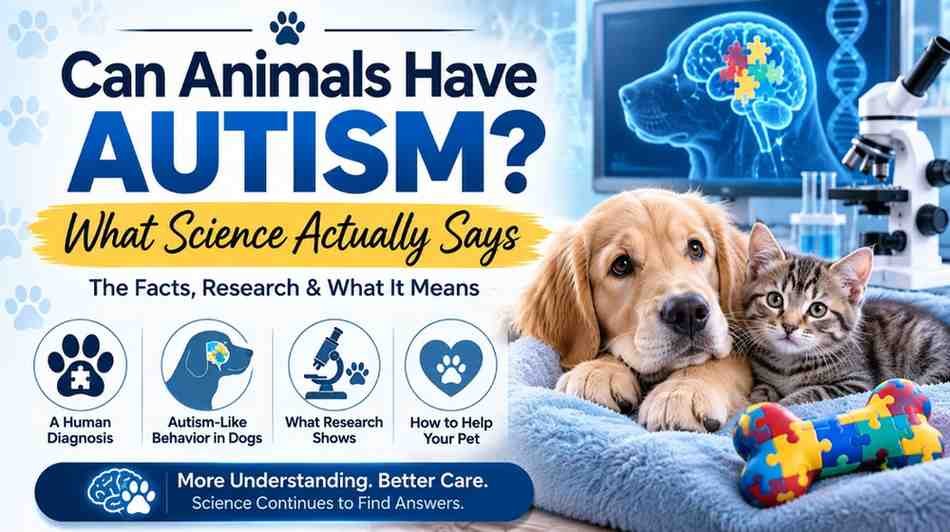
Can Animals Have Autism? What the Research Actually Shows
Anyone who has watched a dog spin in circles, avoid eye contact, or melt down over a loud noise has probably wondered whether that pet could be autistic. It’s a natural question, especially for people who live with autism themselves or care for someone who does. But can animals have autism in the same clinical sense that a person can? The honest answer is more nuanced than a simple yes or no, and understanding it requires separating three very different things: a formal medical diagnosis, a behavioral resemblance, and a scientific research tool.
This article walks through what veterinary medicine says, what behavioral researchers have actually found in dogs and other species, why lab animals are used to study autism at all, and what any of this means if you’re worried about a pet’s behavior.
The Short Answer: Autism Is a Human Diagnosis
Autism spectrum disorder (ASD) is defined in the DSM-5, the diagnostic manual used by psychiatrists and psychologists, based on human social communication, language development, and behavior. No veterinary diagnostic manual, including those used across the United States, recognizes autism as a condition in animals. So in the strictest clinical sense, animals cannot have autism, because the diagnosis simply does not exist in veterinary medicine.
That said, this isn’t the end of the story. Animals, particularly dogs, can display behaviors that look remarkably similar to traits seen in autistic people, and a small but genuine body of research has looked into why. The more accurate way to frame the question is not “can animals have autism,” but “can animals show autism-like behavior, and what does that tell us.”
Autism-Like Behavior in Dogs
Dogs are the most studied animal when it comes to autism-like traits, largely because they live closely with humans and their behavior is easy to observe over time. Veterinarians and animal behaviorists generally avoid the word autism when describing these dogs and instead use the term canine dysfunctional behavior, sometimes shortened to CDB.
Many of the traits people notice in pets are the same ones associated with mild, low support presentations in humans, sometimes described using the DSM-5 framework as level one autism. Dogs with CDB may show a cluster of behaviors that echo human autism traits, including:
- Reduced or absent eye contact with people or other dogs
- Repetitive movements such as spinning, tail chasing, or pacing
- Episodes that look like zoning out or entering a trance-like state
- Strong resistance to changes in environment or routine
- Limited interest in social play or interaction with other animals
- Unusual reactions to sound, touch, or movement, ranging from extreme sensitivity to apparent indifference
- A flatter range of emotional expression than is typical for the breed
One of the more frequently cited lines of research comes from Dr. Nicholas Dodman, a veterinary behaviorist formerly at Tufts University, who studied a cluster of these traits in Bull Terriers, including tail chasing, explosive aggression, and trance-like episodes. His work, along with later genetic research, suggested that at least some of these behaviors have a hereditary component and may share underlying biological pathways with human neurodevelopmental conditions, though the findings are specific to a small number of breeds and behaviors rather than a general theory of canine autism.
It’s worth being clear about what this research does and does not show. It identifies behavioral similarities and, in some cases, shared genetic or neurological features. It does not establish that dogs experience the world the way autistic humans do, and it does not amount to a diagnosis of autism in the veterinary sense.
What Causes These Behaviors in Dogs
Autism-like behavior in dogs is rarely traced to a single cause, and in most cases it isn’t autism at all but another identifiable condition. Before assuming a dog has anything resembling autism, veterinarians typically rule out:
Canine Compulsive Disorder
Repetitive behaviors like tail chasing, excessive licking, or circling are frequently linked to canine compulsive disorder, a recognized condition with genetic and environmental contributors, rather than an autism-like syndrome.
Cognitive Dysfunction Syndrome
In older dogs, disorientation, changes in social interaction, and altered sleep patterns are often signs of canine cognitive dysfunction syndrome, sometimes described as the canine equivalent of dementia, not a developmental condition present from birth.
Underlying Medical Issues
Pain, sensory impairment, thyroid dysfunction, and neurological conditions can all produce behavior that looks like social withdrawal or repetitive movement. A thorough veterinary workup is the only reliable way to rule these out.
Early Development and Environment
Limited socialization during a puppy’s critical developmental window, inconsistent handling, or early trauma can also produce behaviors that resemble autism-like traits without any underlying genetic or neurological cause.
Because so many different issues can produce similar-looking behavior, a dog that avoids eye contact or resists routine changes is far more likely to be dealing with anxiety, compulsive disorder, or a medical issue than anything resembling autism.
Do Other Animals Show Autism-Like Traits
Dogs get the most attention, but they are not the only species researchers have studied. Some research groups, including work led by Japanese researcher Kyoko Yoshida, have examined social deficits in primates, looking at how monkeys respond to social cues and whether atypical mirror neuron activity might parallel patterns seen in autistic humans. This research remains early and specialized, and it’s aimed more at understanding neurological mechanisms than establishing that monkeys can be autistic in a clinical sense.
Beyond primates, laboratory mice are the animal most central to autism science, though not because anyone believes pet mice can be autistic. That distinction deserves its own explanation.
Why Scientists Use Animal Models to Study Autism
Genetic mouse models are one of the most important tools in autism research, and they explain why so much scientific literature seems to connect animals and autism. Researchers introduce specific gene mutations linked to autism risk in humans, such as those affecting synapse formation or neural connectivity, into mice, then observe whether the mice show behavioral patterns that parallel autism’s diagnostic features: reduced social interaction, repetitive behaviors, and altered communication, in this case measured through ultrasonic vocalizations rather than speech.
Strains like BTBR mice, along with mice carrying targeted mutations such as Fmr1, Shank3, or CRMP4 gene changes, have become standard research tools because they reliably display these behavioral patterns. Zebrafish are increasingly used as well, since their nervous systems are easier to study at scale and they can carry equivalent genetic mutations.
These animal models exist purely as scientific tools to understand the biology behind autism spectrum disorder and to test potential treatments, not because researchers believe the animals themselves have autism as humans experience it. It’s a subtle but important distinction: a mouse can serve as a model for studying autism-related genes without being autistic in any clinical or experiential sense.
Autism, Down Syndrome, and ADHD in Animal Research
People sometimes search for whether animals can have autism alongside related neurodevelopmental questions, including Down syndrome or ADHD, and the pattern is similar across all three. Genetic mouse models exist for each of these conditions, since researchers can introduce comparable genetic changes and study resulting behavior and brain development. As with autism, none of these represent an actual clinical diagnosis of Down syndrome or ADHD in the animal. They are experimental models used to understand shared biological pathways, and findings from this research have contributed meaningfully to our understanding of human neurodevelopment, even though the animals themselves are not considered to have the human condition.
What This Means If You’re Concerned About a Pet’s Behavior
If a dog or other pet is showing repetitive movements, social withdrawal, unusual sensory reactions, or resistance to change, the most useful next step isn’t trying to determine whether the animal has autism. It’s getting a proper veterinary evaluation. A veterinarian or certified animal behaviorist can assess whether the behavior stems from a medical condition, canine compulsive disorder, cognitive decline, anxiety, or a socialization gap, and each of those has different management strategies, ranging from environmental changes and behavioral therapy to medication in some cases.
It’s also worth noting that many people specifically interested in autism, including adults who recognize the signs of autism in adults in themselves or a family member, are drawn to this topic because of the well-documented benefits of animal companionship for autistic individuals. Trained service dogs and companion animals can help with sensory regulation, social engagement, and emotional support, a connection that has far more solid evidence behind it than the idea of autism in animals itself.
Frequently Asked Questions
Can dogs be diagnosed with autism?
No. There is no veterinary diagnosis of autism. Dogs can display behaviors that resemble autism traits, generally described as canine dysfunctional behavior, but this is not the same as an autism spectrum disorder diagnosis.
What animal behaviors look most like autism?
Repetitive movements such as tail chasing or circling, reduced eye contact, resistance to routine changes, unusual reactions to sensory input, and limited social interest are the behaviors most often compared to autism traits in humans.
Why do scientists study autism in mice if mice can’t have autism?
Researchers use genetically modified mice as models to study the biological mechanisms linked to autism risk genes. The mice display behaviors with parallels to autism’s diagnostic features, which helps scientists understand underlying neuroscience and test potential treatments, even though the mice are not considered autistic in a clinical sense.
Is canine dysfunctional behavior the same as autism?
No. Canine dysfunctional behavior describes a cluster of atypical behaviors observed in some dogs that resemble certain autism traits. It is a behavioral description used informally in veterinary contexts, not a recognized diagnosis equivalent to human autism.
Should I see a vet if my dog shows autism-like behaviors?
Yes. Behaviors like repetitive movements, social withdrawal, or unusual sensory reactions can stem from several conditions, including compulsive disorder, cognitive decline, anxiety, or an underlying medical issue. A veterinary evaluation is the only reliable way to identify the actual cause and the right treatment approach.
Final Thoughts
So, can animals have autism? Not in the clinical sense used for humans, since autism spectrum disorder remains a diagnosis specific to human development and behavior. What research does show is that some animals, dogs in particular, can display behaviors that closely resemble autism traits, and that scientists rely on genetically modified animal models to study the biology behind autism itself. If a pet’s behavior has you concerned, the most productive path is a veterinary evaluation rather than an autism label, since the underlying cause, and the right way to help, can vary widely from one animal to the next.