Early Signs and Symptoms of Autism in Infants: A Guide by Age
Most parents do not go looking for information on autism until something feels a little off. Maybe your baby does not turn toward their name the way a cousin’s baby did, or they seem uninterested in the back-and-forth games that other infants enjoy. Recognizing the early signs and symptoms of autism in infants is not about diagnosing your child yourself. It is about knowing what to watch for so you can bring specific, concrete observations to your pediatrician instead of a vague sense of worry.
Autism spectrum disorder (ASD) can be reliably diagnosed as early as 18 to 24 months in many children, and researchers have identified behavioral differences that appear even earlier, sometimes in the first six months of life. According to the CDC’s most recent surveillance data, about 1 in 31 children in the United States is identified with autism by age 8, yet the median age of diagnosis remains around 47 months, well after many of the earliest signs first appear. Closing that gap starts with knowing what early signs actually look like in real infants, not in a checklist.
What Autism Looks Like Before a Baby Can Talk
Autism is not something that suddenly appears once a toddler starts missing speech milestones. It shows up first in the building blocks of communication that come before words, things like eye contact, shared attention, imitation, and gesture. Clinicians generally look at two broad categories when assessing a young child for ASD: differences in social communication and interaction, and restricted or repetitive patterns of behavior. For a diagnosis, a child needs to show traits from both categories, not just one.
Because infants cannot yet report how they are feeling or thinking, these categories translate into observable behaviors that parents and pediatricians can watch for during everyday routines like feeding, playtime, and diaper changes.
Early Signs of Autism by Age
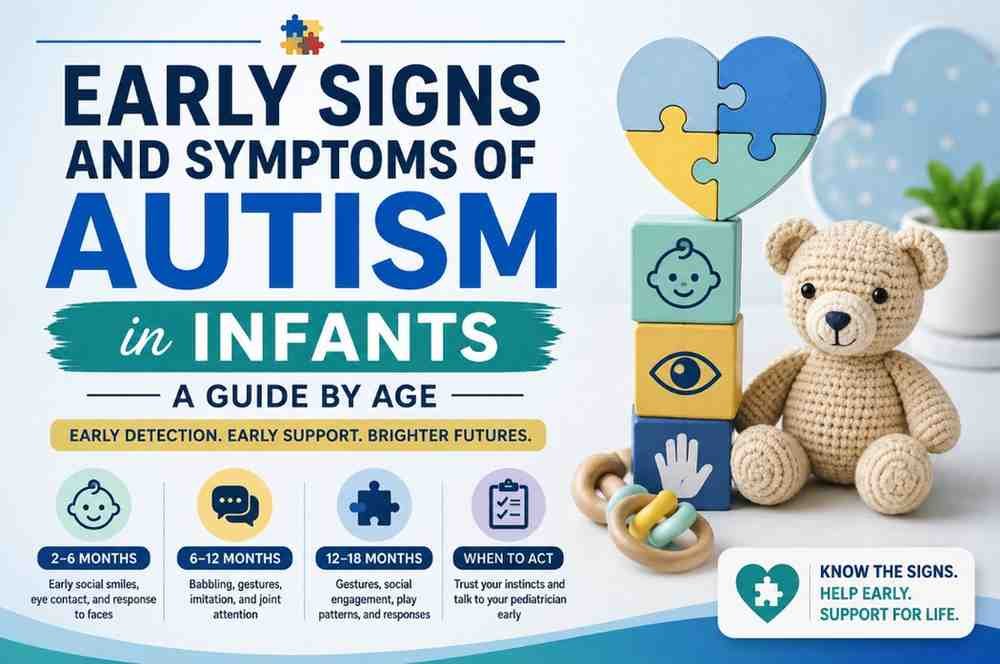
Autism does not present the same way at every stage of infancy. What looks concerning at nine months may look completely different from what raises a flag at eighteen months. Here is a general breakdown by developmental stage, though it is worth remembering that every baby develops on their own timeline, and one missed milestone alone does not indicate autism.
Signs at 2 to 6 Months
In the earliest months, differences tend to be subtle and easy to dismiss, especially with a first child. Some patterns that researchers and clinicians associate with later ASD diagnoses include:
- Limited or infrequent social smiling by around 6 months
- Reduced eye contact, or eye contact that feels fleeting rather than sustained
- Minimal response to a caregiver’s face compared with other visual stimuli
- Low reactivity or unusually flat affect during interaction
- Little interest in being held, cuddled, or engaged in face to face play
None of these signs alone is diagnostic. Plenty of typically developing infants go through phases of being less smiley or more independent. The pattern that matters clinically is a consistent lack of social engagement across multiple interactions, not a single quiet day.
Signs at 6 to 12 Months
This window is when many of the more well-documented early indicators begin to emerge, largely because babies are expected to start using intentional communication.
- Not responding consistently when their name is called, even after hearing it repeatedly
- Limited babbling, or babbling that does not include a typical range of consonant sounds
- Little or no pointing, reaching, or showing objects to a caregiver
- Reduced imitation of sounds, facial expressions, or simple actions like clapping
- Unusual visual behavior, such as staring intently at lights or watching objects out of the corner of the eye
- Delayed motor milestones, including rolling, sitting, or crawling, in some infants
One skill that researchers describe as especially informative is joint attention, the ability to look back and forth between an object and a person to share interest in it. A baby who points at a dog and then looks at a parent to see if they noticed it too is demonstrating joint attention. Infants later diagnosed with autism often show delays or absence of this skill well before delays in spoken language become apparent.
Signs at 12 to 18 Months
By this stage, differences often become more noticeable to parents, partly because more social and communicative milestones are expected.
- Little to no use of gestures such as waving bye-bye, shaking the head for no, or pointing to request something
- Loss of previously acquired words or social skills, sometimes called developmental regression
- Preference for playing alone rather than engaging with caregivers or peers
- Repetitive movements, such as hand flapping, rocking, or repeatedly lining up toys
- Strong, specific reactions to certain sounds, textures, lights, or smells
- Intense focus on parts of objects, like spinning wheels on a toy car, rather than the toy as a whole
Regression, where a child loses skills they previously had, tends to draw particular concern from clinicians because it is a fairly specific pattern rather than a simple developmental delay.
The CDC’s Milestone-Based Approach
The Centers for Disease Control and Prevention publishes developmental milestone checklists through its Learn the Signs. Act Early. program, and pediatricians use these alongside formal screening tools to track development at well-child visits. Rather than diagnosing autism directly, these checklists flag when a child’s social, communication, or motor development falls meaningfully outside the typical range for their age, which then prompts further evaluation.
The American Academy of Pediatrics recommends general developmental screening at the 9, 18, and 30 month well visits, with autism-specific screening using a validated tool, most commonly the Modified Checklist for Autism in Toddlers, Revised (M-CHAT-R), at both the 18 and 24 month visits. This two-step approach, general screening plus autism-specific screening, is designed to catch children who might be missed by developmental screening alone.
Sensory Differences in Infancy
Sensory processing differences are increasingly recognized as an important part of the early autism picture, even though they are not always the first thing parents notice. Some infants who are later diagnosed with autism show heightened sensitivity to sound, becoming distressed by noises that other babies tolerate easily, or the opposite pattern, seeming underresponsive to loud sounds or bright lights. Others show strong reactions to certain textures during feeding or dressing. These sensory patterns often continue well beyond infancy. In fact, sensory sensitivities frequently persist into later life and are commonly described in discussions of signs of autism in adults, where sensory overload and specific sensitivities remain a defining feature for many autistic people well into their adult years.
Why Some Infants Show More Pronounced Early Signs
Not every child who later receives an autism diagnosis shows the same intensity or number of early signs. Some infants display a handful of subtle differences that only become clear in hindsight, while others show more pronounced and pervasive signs from a very young age, often correlating with what will later be assessed as a higher level of support need. Infants who go on to be diagnosed with more significant support needs, sometimes described using the DSM-5 severity framework as level 3 autism, frequently show more noticeable early differences across multiple domains at once, including very limited eye contact, minimal social smiling, and significant delays in babbling and gesture, rather than an isolated delay in just one area.
This variability is part of why autism is described as a spectrum rather than a single, uniform condition. Two infants can both eventually receive an ASD diagnosis while looking quite different from one another during their first year of life.
What to Do If You Notice Early Signs
If you recognize several of these patterns in your baby, the most useful next step is a conversation with your pediatrician, ideally with specific examples rather than a general impression. Instead of saying your baby “seems behind,” it helps to describe concrete observations, such as “she does not turn when I call her name from across the room” or “he has not started pointing at things he wants.”
A few practical steps parents can take:
- Keep a simple log of specific behaviors and the ages at which you noticed them
- Ask directly for autism-specific screening, such as the M-CHAT-R, if it has not already been done
- Request a referral to a developmental pediatrician, child psychologist, or early intervention program if screening results raise concern
- Contact your state’s Early Intervention program directly. In the United States, children under 3 can often be referred for evaluation without waiting for a formal autism diagnosis
- Avoid a wait and see approach if concerns persist across multiple visits, since earlier evaluation generally means earlier access to support
Early intervention programs, including services covered under Part C of the Individuals with Disabilities Education Act, do not require a confirmed autism diagnosis to begin. A child can start receiving speech, occupational, or developmental therapy based on delays alone, which means acting on early signs does not have to wait for a formal ASD label.
Signs That Do Not Necessarily Mean Autism
It is worth saying clearly that many of the behaviors described above can appear in typically developing infants, in premature babies catching up on milestones, or in children with other developmental or sensory conditions unrelated to autism. A baby who is briefly less social during an illness, a growth spurt, or a period of change at home is not automatically showing signs of autism. What matters clinically is a persistent pattern across settings and time, evaluated by a professional trained in early childhood development, rather than a single observation taken in isolation.
Frequently Asked Questions
How early can you tell if a baby will have autism?
Subtle behavioral differences, such as reduced eye contact or limited social smiling, can sometimes be observed as early as 6 months, and autism can often be reliably diagnosed by 18 to 24 months. Diagnosis before 12 months is uncommon but not impossible in cases with clear, consistent signs.
What are the top 3 signs of autism in infants?
While no single sign is definitive, three of the most consistently studied early indicators are limited eye contact, reduced or absent response to their name being called, and delayed or absent use of gestures such as pointing and waving.
Can autism be diagnosed before 12 months?
It is uncommon, but some children with pronounced early signs across multiple domains have been diagnosed before their first birthday. Most clinicians prefer to wait until 18 to 24 months, when developmental patterns are more stable and easier to distinguish from normal variation.
What activities help babies showing early signs of autism?
Simple interactive activities, such as peekaboo, imitation games, and joint attention exercises where you point at objects and describe them, can support social and communication development. These activities are helpful for all infants and are often incorporated into early intervention programs for babies showing possible signs of autism.
Do all babies with early signs go on to be diagnosed with autism?
No. Many infants who show one or two early signs do not go on to receive an autism diagnosis, since developmental variation is common in typically developing children. Persistent signs across multiple areas of development, confirmed through professional screening and evaluation, carry more diagnostic weight than an isolated behavior.
Final Thoughts
Understanding the early signs and symptoms of autism in infants gives parents a practical way to notice when something is worth discussing with a pediatrician, without turning every quiet or independent moment into cause for alarm. The signs tend to cluster around social communication, from eye contact and smiling to gestures and response to name, alongside early patterns of repetitive movement or sensory sensitivity. If several of these signs appear consistently, timely screening and a referral for evaluation give your child the best chance at accessing early intervention, which remains one of the most well-supported ways to improve outcomes for children on the autism spectrum.