What Causes Autism? What Research Actually Shows in 2026
Autism spectrum disorder (ASD) is one of the most researched neurodevelopmental conditions in medicine, yet the question “what causes autism” still brings up confusion, myths, and conflicting claims online. The honest, evidence-based answer is that autism does not have one single cause. It results from a combination of genetic and prenatal biological factors that shape how a child’s brain develops, often long before birth.
This article breaks down what decades of genetic research, large population studies, and clinical evidence actually say about the causes of autism, what has been ruled out, and what remains an open question in ongoing autism research.
Autism Is a Difference in Brain Development, Not a Disease
Autism spectrum disorder is a developmental condition, not an illness caused by a germ, infection, or injury. It reflects differences in how the brain develops and processes information, which is why autism affects communication, social interaction, and behavior in ways that vary widely from person to person.
Some individuals with autism have an identifiable genetic condition connected to their diagnosis. For others, no single cause can currently be identified, even after full genetic testing. This is why researchers describe autism as a spectrum with multiple possible pathways rather than one uniform condition with one origin.
Genetics Is the Strongest Known Factor in Autism
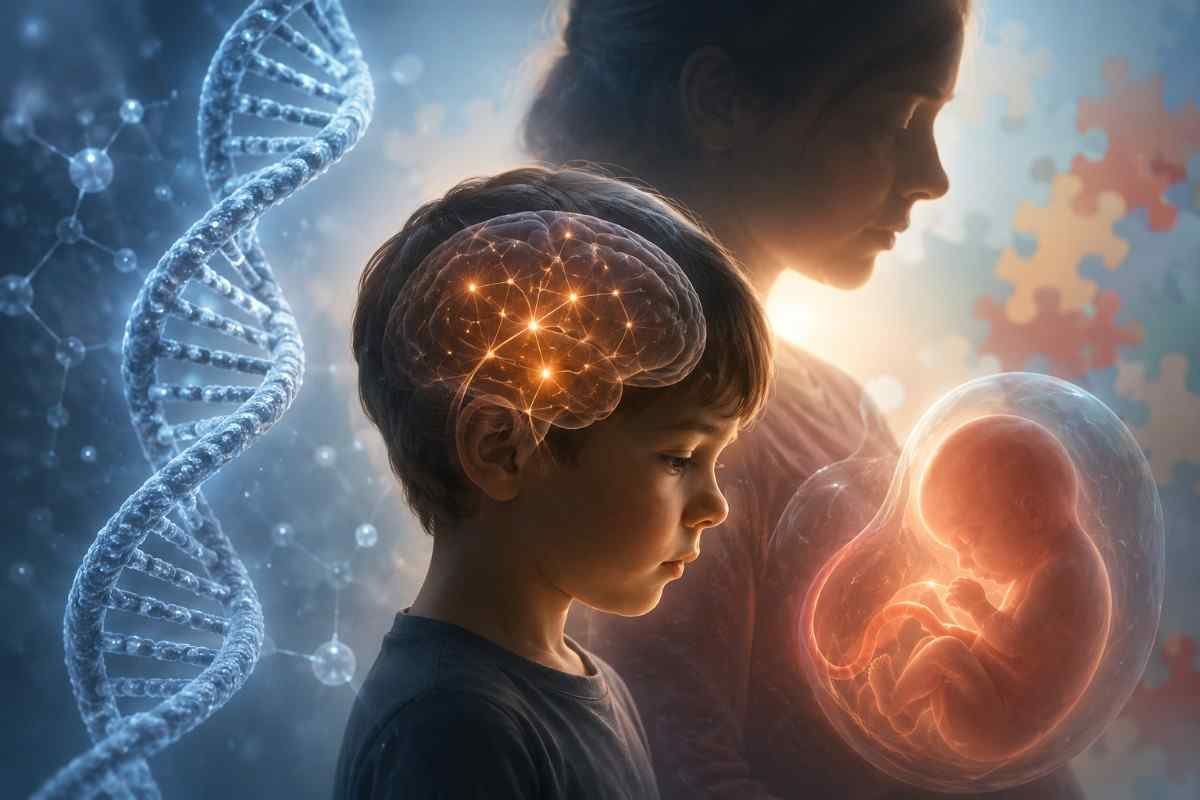
Of everything studied so far, genetics has the strongest and most consistent evidence behind it. Large twin and family studies estimate that genetic factors account for a substantial majority of autism risk, with heritability estimates commonly cited between 60 and 90 percent depending on the population studied.
What the genetic research shows
Autism genetics research has identified several distinct patterns:
- Inherited genetic variants. Autism often runs in families. If one child is diagnosed, siblings have a meaningfully higher likelihood of also being diagnosed compared to the general population.
- De novo mutations. These are new genetic changes that appear spontaneously in a child and are not inherited from either parent. They occur more frequently as parental age increases.
- Syndromic autism. Some cases of autism are linked to identifiable genetic syndromes, including fragile X syndrome and tuberous sclerosis complex, where autism is one feature of a broader genetic condition.
- Polygenic risk. In many cases, no single gene is responsible. Instead, a combination of many common genetic variants, each contributing a small amount of risk, adds up to increase overall likelihood.
A notable development in recent genetic research is the growing recognition that autism may represent several biologically distinct subtypes rather than one uniform disorder. Genome-wide studies comparing children diagnosed earlier in life with those diagnosed later have found different genetic patterns between the two groups. Children diagnosed earlier tend to show rare, high-impact genetic variants, while those diagnosed later often show a genetic profile more closely associated with traits like ADHD or differences in educational attainment. This distinction is helping researchers understand why autism presents so differently from one individual to another.
Environmental and Prenatal Factors: What the Evidence Actually Supports
Genetics sets the underlying susceptibility, but researchers have also identified prenatal and perinatal factors associated with higher autism likelihood. It is important to understand that “environmental” in this context refers mainly to the biological environment in the womb and around birth, not lifestyle choices or parenting.
Advanced parental age
Multiple large meta-analyses have found a consistent association between older parental age and increased autism likelihood. Research shows that with every ten-year increase in parental age, the associated risk rises by roughly 18 to 21 percent, with paternal age showing a particularly strong association. The most likely biological explanation is an accumulation of de novo genetic mutations in sperm and egg cells over time. The effect is strongest when both parents are older.
Pregnancy and birth complications
Several pregnancy-related conditions have shown a consistent association with autism in systematic reviews, including:
- Preterm birth and low birth weight
- Gestational diabetes and pregestational diabetes
- Preeclampsia and other hypertensive disorders of pregnancy
- Maternal infection or fever during pregnancy
- Complications involving reduced oxygen to the baby during birth
- Severe neonatal jaundice requiring treatment
None of these factors causes autism on its own in most cases. They are associated with a statistically higher likelihood, particularly when layered onto existing genetic susceptibility.
Maternal health during pregnancy
Maternal obesity, immune conditions, and untreated chronic illness during pregnancy have also been linked to modestly elevated autism likelihood in offspring, likely through their effects on fetal brain development and the intrauterine environment.
Certain medications during pregnancy
Prenatal exposure to sodium valproate, an anti-seizure and mood-stabilizing medication, is one of the most well-documented pharmaceutical risk factors identified in multiple independent studies. This is why healthcare providers carefully weigh medication choices for pregnant patients who require seizure or mood disorder management.
Environmental toxin exposure
Some studies have found associations between prenatal exposure to air pollution, certain pesticides, and heavy metals such as lead and researchers have proposed oxidative stress and disruption of fetal neurodevelopment as possible mechanisms. This area of research is still developing, and while associations exist, causation has not been firmly established the way it has for genetic factors.
What Does Not Cause Autism
Given how much misinformation circulates around this topic, it is worth being direct about what large-scale scientific research has ruled out.
Vaccines do not cause autism
This is one of the most extensively studied questions in modern medicine. Multiple large population studies, involving millions of children across different countries, have consistently found no association between vaccination and autism diagnosis. This includes specific research on the MMR vaccine and on thimerosal, a preservative once used in some vaccines that is no longer present in childhood vaccines in most countries. Major health authorities, including the CDC and the World Health Organization, affirm that vaccines do not cause autism, and this conclusion is regarded as firmly established in the scientific literature.
It’s worth noting that public discussion around this topic has continued in 2026, including debate over how health agencies word their online guidance on autism’s causes. This ongoing public conversation does not reflect any change in the underlying scientific evidence, which remains consistent: vaccines are not a cause of autism.
Parenting style does not cause autism
Autism is not the result of parenting choices, emotional bonding, or how a caregiver raises a child. This idea, sometimes called the “refrigerator mother” theory, was a discredited hypothesis from the mid-20th century and has no support in modern research.
Diet and screen time do not cause autism
While nutrition and healthy routines matter for overall child development, there is no credible evidence that diet, sugar intake, or screen exposure causes autism. These factors may affect symptom management or daily functioning for some children, but they are not root causes.
Why “One Cause” Thinking Is Outdated
Older explanations of autism, including germ theory-based models of disease, sought a single infectious or external cause. Modern autism research has moved firmly away from this framework. Autism is now understood as a multifactorial condition, meaning it emerges from the interaction of many small contributing factors rather than one dominant trigger.
A useful way to think about it: genetic susceptibility sets the underlying vulnerability, and certain prenatal or perinatal conditions may interact with that susceptibility to influence how brain development unfolds. This layered model explains why two children with similar genetic backgrounds can have very different outcomes, and why no single test or exposure can predict autism on its own.
Can Autism Be Diagnosed Through Genetic Testing?
Genetic testing, including chromosomal microarray analysis and whole exome sequencing, can identify a specific genetic cause in a meaningful subset of autism cases, particularly when autism occurs alongside other developmental conditions or physical features. However, most autism diagnoses are still made through developmental and behavioral evaluation rather than genetic testing, because a large proportion of cases involve complex polygenic patterns rather than one identifiable gene.
Early Signs and the Importance of Early Intervention
Regardless of underlying cause, research consistently shows that early identification and early intervention services significantly improve developmental outcomes for children with autism. Common early signs that prompt evaluation include:
- Limited eye contact or reduced response to their name by 12 months
- Delayed or absent speech and language milestones
- Repetitive movements or intense focus on specific interests
- Difficulty with social or reciprocal play
- Sensory sensitivities to sound, light, or texture
Autism can be reliably diagnosed as early as 18 to 24 months in many children, and starting developmental support early gives children the best opportunity to build communication, social, and adaptive skills.
Frequently Asked Questions
What is the main cause of autism?
There is no single main cause. Genetics is currently the strongest and most well-established contributing factor, with prenatal and perinatal conditions playing a secondary, interacting role.
Is autism genetic or caused by environment?
Both play a role, but they are not equal. Genetics is estimated to account for the majority of autism risk, while environmental and prenatal factors appear to modify or interact with that underlying genetic susceptibility rather than independently causing autism in most cases.
Do vaccines cause autism?
No. This has been studied extensively across large populations, and no scientific evidence supports a link between vaccination and autism.
Can autism be prevented?
Because autism largely stems from genetic and early prenatal factors, many of which are not modifiable, there is no reliable way to prevent it. Managing chronic health conditions during pregnancy, attending regular prenatal care, and avoiding known risk exposures where possible may support healthy fetal development in general, but cannot guarantee prevention of autism.
At what age is autism usually diagnosed?
Many children are diagnosed between ages 2 and 4, although reliable diagnosis is possible as early as 18 months when developmental differences are apparent.
Does advanced parental age increase autism risk?
Yes, research consistently shows a modest but real increase in autism likelihood associated with older parental age, particularly paternal age, likely due to age-related genetic mutations.
Key Takeaway
Autism spectrum disorder arises from a complex interaction between genetic susceptibility and certain prenatal or perinatal biological factors. It is not caused by vaccines, parenting, or diet. While science has not identified every mechanism involved, the evidence clearly points to genetics as the leading factor, with environmental influences acting alongside it rather than independently. Ongoing research continues to refine our understanding of the different biological pathways that lead to autism, which may eventually help tailor earlier identification and more personalized support for autistic individuals and their families.