
What a “Spiky Skill Profile” Means for Autistic People
An autistic teenager might read at a college level while still needing help remembering to pack lunch, or solve advanced math problems and struggle to follow a three-step spoken instruction. That kind of unevenness has a name: a spiky skill profile, and it shows up in autistic people far more often than a smooth, even set of abilities does.
What “spiky” describes
Most standardized testing assumes ability comes in a fairly even spread — verbal, reasoning, and working-memory skills clustered close together. A spiky skill profile means the gaps between those areas are unusually wide for one person. Someone might score in a gifted range for vocabulary and pattern recognition while scoring well below average for processing speed or working memory, and both numbers can be true for the same person at the same time.
This is not a flaw in the person; it is a description of how unevenly the underlying cognitive skills happen to be distributed. Research comparing cognitive profiles in autistic children has repeatedly found this pattern of strong and weak areas sitting much further apart than is typical — not one general ability level, but several different ones running in parallel.
Where it causes friction
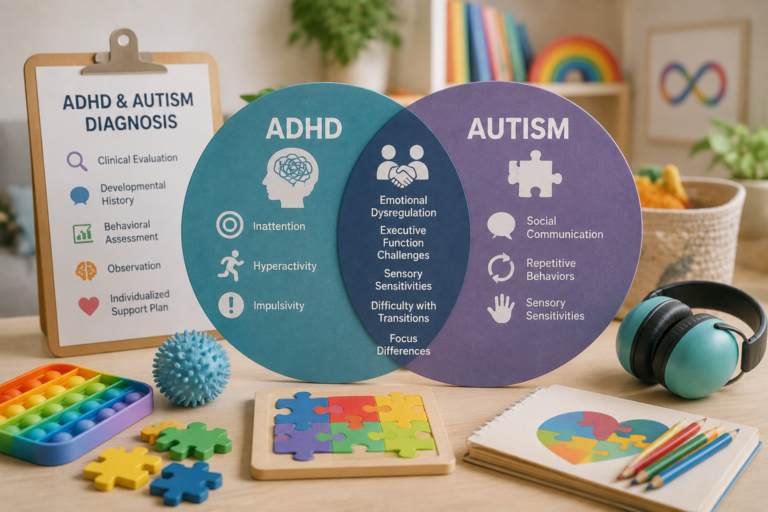
The friction usually is not the skills themselves — it is other people’s expectations, calibrated to whichever skill they have seen most recently. A student who writes brilliant essays gets assumed to be careless when they cannot organize their backpack. An adult who can hold an expert-level conversation about their field gets assumed to be exaggerating when they say a two-step verbal instruction did not land. The profile reads as inconsistency to an observer, when it is simply as consistent as anyone else’s abilities — just spread further apart. This unevenness sometimes overlaps with co-occurring conditions like ADHD, which can independently affect processing speed and working memory.
What helps
Support works best when it is matched to the specific gap rather than to a general label like “smart” or “behind.” A written checklist can cover for a working-memory gap that a verbal reminder never will. Extra time helps a slow-processing-speed gap; it does nothing for a reading gap, and vice versa. An IEP or 504 plan can be written around the actual shape of a person’s profile instead of a single overall grade level, and it is worth asking a school team to do exactly that.
If a spiky profile is making school, work, or daily life harder than it needs to be, a full evaluation from a psychologist who specializes in cognitive testing can map out where the peaks and valleys are — far more useful than guessing from report cards or performance reviews.
It also helps to say the shape out loud, to teachers, employers, or family, rather than letting them guess at it from scattered evidence: “reading and vocabulary are strong, working memory is not — instructions land better written down.” That one sentence does more than a general label ever could. The unevenness is not something to smooth over. It is information about where support needs to go.