
ADHD and Autism Diagnosis: How the Two Conditions Overlap
For years, clinicians were not permitted to diagnose ADHD and autism in the same person. If a child met criteria for autism spectrum disorder, any attention or impulsivity issues were usually folded into that diagnosis rather than assessed on their own. That changed with the DSM-5 in 2013, which removed the exclusion rule and allowed both diagnoses to be given together. Since then, research and clinical practice have caught up to what many families and adults already suspected: ADHD and autism frequently occur in the same person, and figuring out which traits belong to which condition is one of the more complicated jobs in developmental and mental health assessment.
This guide walks through what an ADHD and autism diagnosis actually involves, how the two conditions overlap and differ, what the evaluation process looks like for children and adults, and what to expect if you are trying to get assessed yourself.
Can You Have Both ADHD and Autism?
Yes. Autism spectrum disorder (ASD) and attention-deficit/hyperactivity disorder (ADHD) are classified as separate neurodevelopmental conditions, but they co-occur at a much higher rate than would be expected by chance. Estimates vary across studies, partly because of differences in how samples are recruited and which assessment tools are used, but research generally suggests that a substantial proportion of autistic children and adults also meet criteria for ADHD, and a smaller but still notable share of people diagnosed with ADHD also meet criteria for autism.
Some clinicians and researchers use the informal term “AuDHD” to describe this combined presentation, though it is not a formal diagnostic label in the DSM-5-TR or ICD-11. Instead, a person receives two separate diagnoses, autism spectrum disorder and ADHD, when both sets of criteria are independently met.
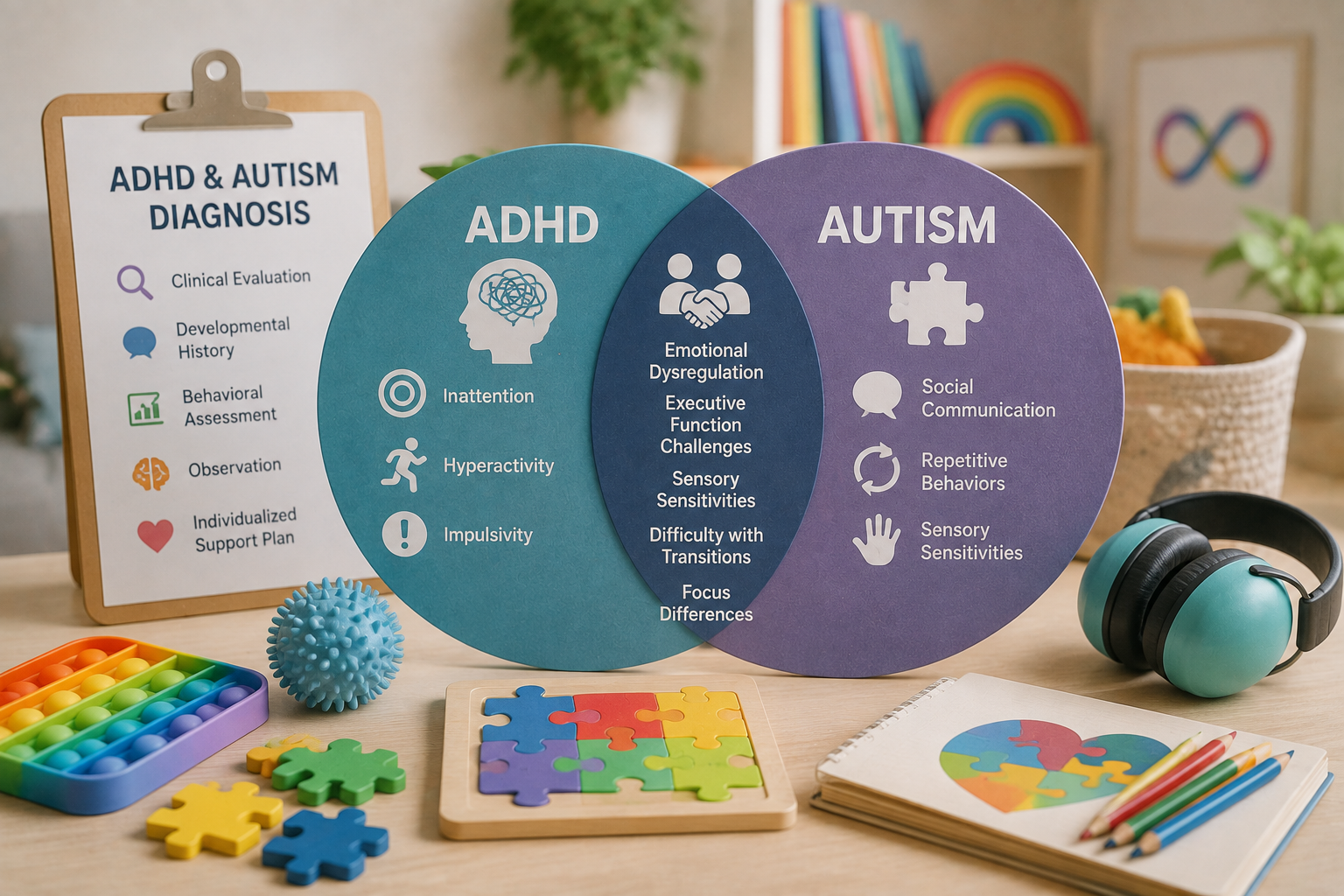
The reason this distinction took so long to formalize comes down to symptom overlap. Both conditions can involve difficulty with attention, restlessness, trouble with transitions, and challenges regulating emotions. Without careful assessment, it is easy for a clinician to attribute every symptom to whichever condition is more familiar or more obvious at first glance.
Where ADHD and Autism Look Alike, and Where They Differ
Because both conditions affect attention, behavior, and social functioning, families and even experienced clinicians can struggle to separate them without a structured evaluation.
Overlapping Traits
- Difficulty sustaining attention on non-preferred tasks
- Restlessness or a need to move
- Trouble with executive function, including planning, organizing, and time management
- Sensory sensitivities to noise, texture, or light
- Difficulty with emotional regulation
- Social awkwardness or friction in peer relationships
Where the Two Conditions Diverge
The underlying reason for a behavior often differs even when the behavior looks similar on the surface.
- Social difficulty: In ADHD, social struggles usually stem from impulsivity, interrupting, or missing social cues because attention has drifted. In autism, social differences more often relate to difficulty reading nonverbal communication, a preference for directness over implied meaning, or differences in reciprocal conversation.
- Repetitive behavior: Autism is defined in part by restricted or repetitive behaviors and intense, focused interests. ADHD does not include this criterion, although some people with ADHD do develop strong hobbies or hyperfocus periods.
- Attention patterns: A person with ADHD is often inattentive across most settings, including ones they enjoy. A person with autism may show intense, sustained focus on a specific interest while struggling to attend to unrelated tasks.
- Sensory processing: Sensory sensitivity is a core diagnostic feature of autism. It can appear in ADHD as well, but it is not part of the formal criteria.
- Onset and developmental history: Autism is typically identifiable through early developmental differences in communication and social interaction, even if a person is not diagnosed until later in life. ADHD symptoms are also required to appear in childhood, but the specific pattern of early signs differs from the social and communication markers used in autism assessments.
The Differential Diagnosis Process
Differential diagnosis is the clinical process of ruling in or ruling out conditions that share overlapping symptoms. For ADHD and autism, this is especially important because a mistake in either direction, missing autism because ADHD looks like the obvious explanation, or missing ADHD because it gets overshadowed by an existing autism diagnosis, can delay appropriate support for years.
Clinicians are trained to watch for a common error known as diagnostic overshadowing, where a new symptom is automatically attributed to an existing diagnosis rather than evaluated on its own. A related issue is double counting, where the same behavior is used as evidence for both conditions instead of being traced back to its actual cause. To avoid this, evaluators typically ask about the context in which a symptom occurs. Inattention that shows up even when a person is alone and free of social demands points more toward ADHD, while attention difficulty that is specific to social or unstructured situations may point toward autism-related factors instead.
A thorough differential evaluation usually considers other conditions that can mimic or coexist with ADHD and autism, including anxiety disorders, obsessive-compulsive disorder, learning disabilities, sensory processing differences, and, in adults, conditions such as complex trauma responses that can produce similar attention and social symptoms.
Autism and ADHD Dual Diagnosis: What It Means Day to Day
Receiving both diagnoses does not simply mean a person has “more” symptoms. Research indicates that people with co-occurring ADHD and autism often experience a different, and sometimes more significant, pattern of functional impairment than those with either condition alone. Executive function challenges can compound, since both conditions independently affect planning and organization. Emotional regulation difficulties may be more pronounced. Social fatigue can build faster when impulsivity and social communication differences interact.
On the other hand, an accurate dual diagnosis often leads to better-targeted support, because interventions can be adjusted to address both attention regulation and the social, sensory, and communication needs associated with autism. It’s worth noting that autism itself is not a single, uniform presentation. Because support needs and strengths vary so widely across the spectrum, it can help to understand the different types of autism before assuming that a dual diagnosis will look the same from one person to the next.
Diagnosis in Children Compared With Adults
Getting a Diagnosis for a Child
In children, ADHD and autism assessments typically start with a referral from a pediatrician, school psychologist, or family physician after caregivers or teachers raise concerns. A comprehensive evaluation usually includes:
- A detailed developmental history, including early language, motor, and social milestones
- Standardized questionnaires completed by parents and teachers
- Direct observation of the child, often using structured tools
- Cognitive and academic testing when learning differences are suspected
- Input from multiple settings, since symptoms that only appear at home or only at school change the diagnostic picture
Because insurance coverage, wait times, and access to specialists vary widely by region, many families search for providers “near me” who accept their insurance and have experience with both conditions, since not every general pediatric or psychiatric provider is trained to differentiate them.
Adult ADHD and Autism Diagnosis
Adult diagnosis has become far more common in recent years, partly because awareness has grown and partly because many people who were overlooked as children, particularly those who learned to mask their traits, are now seeking answers later in life. Adult evaluations rely heavily on self-report, retrospective developmental history, and, when possible, input from parents or old school records, since clinicians need evidence that symptoms were present in childhood even if they were never formally diagnosed.
Adult presentations can look different from childhood ones. Hyperactivity in ADHD often shifts from visible restlessness to an internal sense of restlessness or racing thoughts. Autistic traits in adulthood can be harder to spot because many adults, especially those socialized to mask, have developed compensatory strategies that hide difficulties in unfamiliar settings. If you’re trying to work out whether your own experiences fit an autism profile, it can help to first review common signs of autism in adults, since many of these traits are easy to misattribute to anxiety, ADHD alone, or personality style before a formal evaluation clarifies the picture.
How to Get an ADHD and Autism Diagnosis
The path to diagnosis generally follows these steps, whether through a public health system, insurance-based care, or a private clinic:
- Initial referral or self-referral. This may come from a primary care doctor, therapist, school, or, in many regions, directly from the individual seeking assessment.
- Screening questionnaires. Standardized rating scales help determine whether a full evaluation is warranted.
- Comprehensive clinical interview. A psychologist, psychiatrist, or developmental specialist gathers a detailed history covering childhood development, current functioning, and family history.
- Structured diagnostic tools. Depending on the clinic, this may include tools such as the Autism Diagnostic Observation Schedule (ADOS-2), the Autism Diagnostic Interview-Revised (ADI-R), the Diagnostic Interview for ADHD in Adults (DIVA-5), or clinician-administered ADHD rating scales.
- Multidisciplinary review. For complex cases, especially where both conditions are suspected, some clinics involve a team that may include a psychologist, psychiatrist, speech-language pathologist, or occupational therapist.
- Feedback and report. The evaluator explains the results, provides a written report, and discusses next steps, whether that means therapy, accommodations, medication, or further evaluation.
Wait times and out-of-pocket costs vary considerably. Public health systems in many countries have long waiting lists for specialist autism and ADHD assessments, which has led to growth in private assessment clinics and online or telehealth evaluation services. These private and online options can shorten wait times, but it’s worth confirming that the clinician is qualified to assess both conditions and is not simply screening for one while assuming the other is either present or absent. Not every private provider is allowed, licensed, or credentialed to issue a formal diagnosis in every jurisdiction, so checking credentials before booking an assessment is a reasonable step.
Why an Accurate Diagnosis Matters
An accurate ADHD and autism diagnosis, whether it results in one label or both, shapes the support a person receives. Schools use documented diagnoses to determine eligibility for accommodations such as extended test time, sensory breaks, or individualized education plans. Workplaces may use a diagnosis to support requests for reasonable accommodations. Treatment planning also depends on getting the diagnosis right: stimulant medications commonly used for ADHD, for instance, are generally well studied in ADHD alone, but response and side-effect profiles can differ when ADHD co-occurs with autism, which is one reason a careful diagnostic workup matters before starting treatment.
Beyond formal accommodations, many people describe real value in simply having language for their experience. Understanding why certain environments feel overwhelming, why some tasks are effortless while others feel impossible, or why social interactions take more energy than they seem to for others, can reduce self-blame and guide more effective coping strategies, therapy approaches, and daily routines.
Frequently Asked Questions
Can a child be diagnosed with both ADHD and autism at the same appointment?
Yes, if a comprehensive evaluation is conducted and the child meets criteria for both conditions, a clinician can provide both diagnoses following that assessment, since the DSM-5 permits concurrent diagnosis.
What is the difference between ADHD and autism in terms of social behavior?
ADHD-related social difficulty usually stems from inattention, impulsivity, or interrupting others, while autism-related social differences more often involve challenges with nonverbal communication, reciprocal conversation, or reading unspoken social expectations. A clinician evaluates the underlying cause rather than just the visible behavior.
How long does an adult ADHD and autism evaluation usually take?
This varies by provider, but a thorough adult evaluation covering both conditions often takes several hours across one or more appointments, plus time for questionnaires, developmental history gathering, and report writing. Brief single-session screenings exist but are generally less comprehensive than a full diagnostic workup.
Is it possible to have autism traits without meeting full diagnostic criteria?
Yes. Some people show autistic traits or a broader autism phenotype without meeting the full threshold for a clinical diagnosis. This is different from a formal ASD diagnosis, which requires that symptoms cause significant impairment across multiple settings and meet all specified DSM-5 criteria.
Do I need a referral to get evaluated for ADHD and autism as an adult?
It depends on the healthcare system and country. Some public health services require a referral from a general practitioner, while many private and online assessment clinics accept self-referrals directly. Checking with local providers is the most reliable way to confirm the requirement in your area.
Final Thoughts
ADHD and autism are distinct conditions with their own diagnostic criteria, but their overlapping traits mean that an accurate diagnosis depends on a careful, structured evaluation rather than a quick impression. Whether you’re seeking answers for a child or considering an evaluation for yourself as an adult, understanding how clinicians distinguish between the two, and where they can coexist, makes it easier to ask informed questions, choose the right provider, and get support that actually fits your experience.