Level 2 Autism: Symptoms, Support Needs, and What to Expect
Level 2 autism is one of three severity levels defined in the DSM-5 for diagnosing autism spectrum disorder, and it describes individuals who require substantial support with social communication and who show more noticeable restricted or repetitive behaviors than those at level 1. If your child, a family member, or you yourself have recently received this diagnosis, it’s natural to want a clear, accurate picture of what it actually means day to day, not just a clinical label. This guide walks through what level 2 autism looks like in practice, how it differs from levels 1 and 3, how it’s diagnosed, and what kind of support genuinely helps.
What Is Level 2 Autism?
To understand what level 2 autism is, it helps to start with how the diagnostic system works. The DSM-5, the diagnostic manual used by clinicians in the United States, replaced older separate diagnoses like Asperger’s syndrome and classic autistic disorder with a single category: autism spectrum disorder. Within that category, clinicians assign a severity level from 1 to 3 for two separate domains, social communication and restricted or repetitive behaviors, based on how much support a person needs to function in daily life.
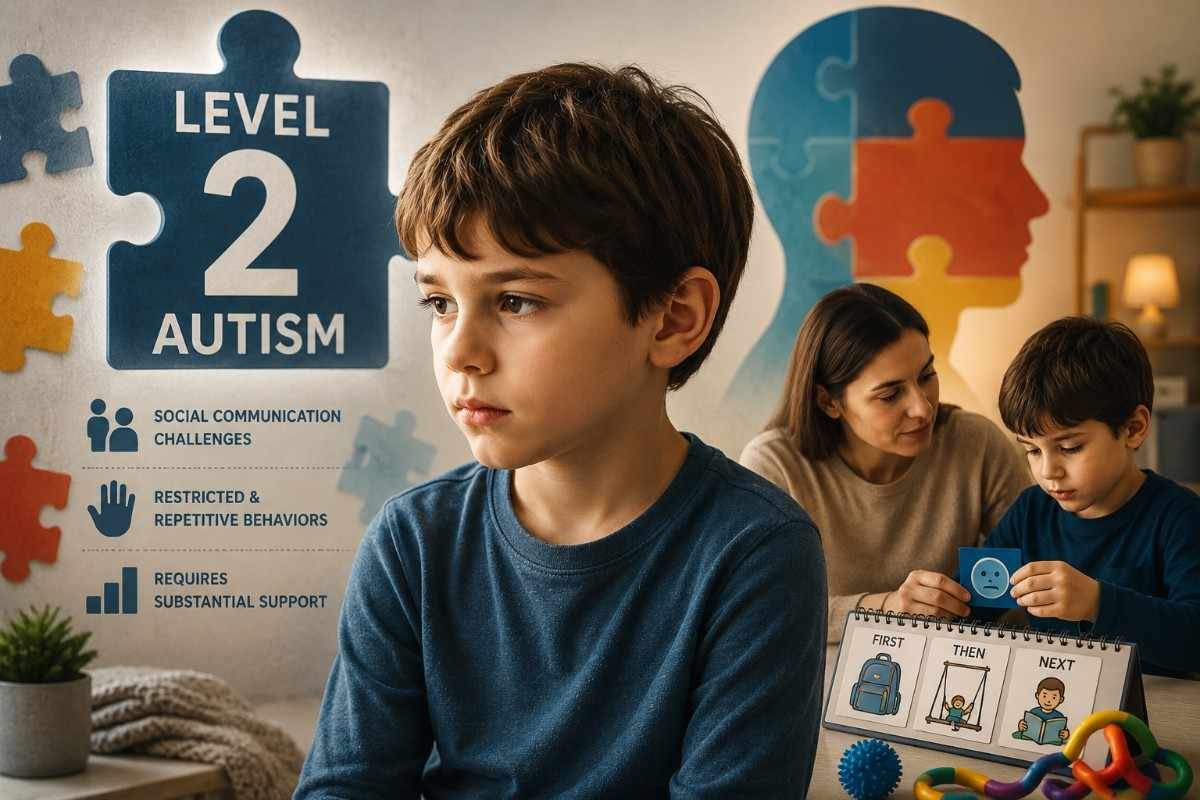
Level 2 sits in the middle. It is officially described as “requiring substantial support,” which distinguishes it from level 1 (“requiring support”) and level 3 (“requiring very substantial support”). This is not a measure of intelligence or personal worth. It’s a clinical description of support intensity, and it can look quite different from one person to another, since autism itself is highly individual.
Level 2 Autism Symptoms and Characteristics
Level 2 autism symptoms generally fall into two categories that mirror the DSM-5 diagnostic framework: challenges with social communication and patterns of restricted or repetitive behavior.
Social communication challenges
People with level 2 autism typically show noticeable differences in both verbal and nonverbal communication, even with support in place. This can include:
- Limited initiation of social interaction, or interactions that are unusual or one-sided
- Reduced or atypical eye contact and facial expression
- Difficulty adapting communication style to different social contexts
- Speech that may be simple, repetitive, or focused narrowly on specific topics
- Trouble understanding unspoken social rules, sarcasm, or figurative language
Unlike level 1, where social difficulties are present but less disruptive, level 2 autism symptoms tend to be apparent to others even during a brief interaction, and they interfere more directly with everyday social functioning at school, work, or in the community.
Restricted and repetitive behaviors
The second core feature involves repetitive behaviors and restricted interests that are frequent enough or intense enough to be noticeable in multiple settings. Common examples include:
- Repetitive body movements such as rocking, hand-flapping, or spinning
- Strong resistance to changes in routine or environment
- Highly focused, intense interests that dominate conversation or attention
- Sensory sensitivities to sound, light, texture, or touch
- Difficulty coping when a preferred routine is interrupted, sometimes leading to distress
These behaviors are usually noticeable to a casual observer, which is one of the practical differences clinicians use when distinguishing level 2 from level 1.
Autism Level 2 Compared to Level 1 and Level 3
Understanding autism level 2 is easier in context. The three DSM-5 levels exist on a spectrum of support need, not a scale of severity in the everyday sense of the word.
Autism Level 2 vs Autism Level 1: Key Differences
At level 1, a person can often communicate in full sentences and function fairly independently, though they may struggle with the nuances of social interaction and prefer routine. Support needs are real but less intensive.
At level 2, difficulties are more pronounced. Social communication deficits are apparent even with supports in place, and repetitive behaviors or resistance to change occur often enough to interfere with functioning across more than one setting. Level 1 vs level 2 autism essentially comes down to how much structured support a person needs to manage daily life and how visible the challenges are to others.
Level 3, by comparison, involves very substantial support needs, often including minimal verbal communication, extreme difficulty coping with change, and behaviors that significantly limit independent functioning. Someone with level 2 autism generally has more functional communication and flexibility than someone at level 3, but more pronounced needs than someone at level 1.
It’s worth noting these levels can shift over time. A person’s needs may look different at age 4 than at age 14, and level assignment is meant to be reassessed periodically rather than treated as fixed for life.
Diagnosing Level 2 Autism: Assessment and Criteria
There is no blood test or brain scan that diagnoses level 2 autism. Diagnosis relies on comprehensive developmental evaluation by a qualified clinician, typically a developmental pediatrician, child psychologist, psychiatrist, or a multidisciplinary team.
The assessment process usually includes:
- A detailed developmental history from parents or caregivers
- Direct behavioral observation, often using standardized tools such as the Autism Diagnostic Observation Schedule (ADOS-2)
- Structured caregiver interviews, such as the Autism Diagnostic Interview-Revised (ADI-R)
- Cognitive and language testing to understand strengths and challenges
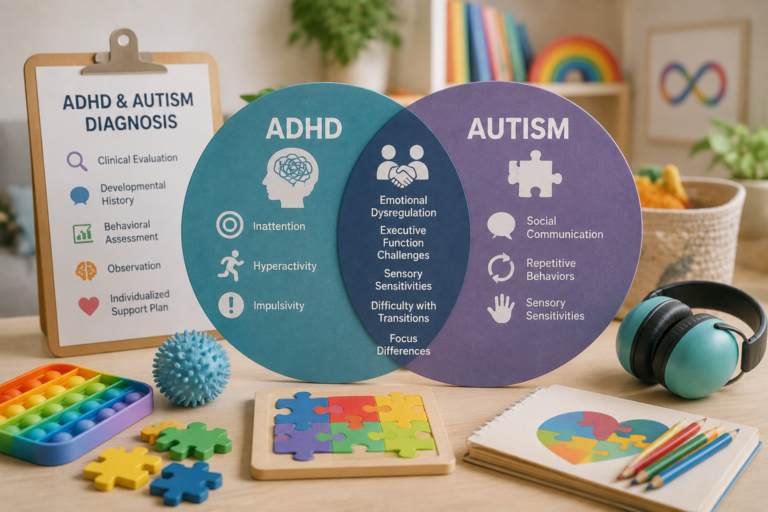
- Screening for co-occurring conditions, since autism frequently overlaps with ADHD, anxiety, intellectual disability, or sensory processing differences
The severity level is determined by combining clinical observation with how much support the individual needs in real-world settings, not by a single test score. This is why an experienced evaluator, and often input from teachers or caregivers who see the person in different contexts, matters for an accurate diagnosis of level 2 autism.
Signs in toddlers versus adults
Level 2 autism in toddlers often shows up as delayed or unusual speech development, limited response to their name, minimal pointing or shared attention, and strong reactions to sensory input or routine changes. In adults, especially those diagnosed later in life, level 2 autism may present as long-standing difficulty maintaining employment or relationships, intense and narrow interests, a strong need for predictability, and sensory sensitivities that others may not have recognized as autism-related earlier in life.
Is Level 2 Autism High-Functioning? Clearing Up a Common Misconception
Terms like “high-functioning” and “low-functioning” autism are not part of the current DSM-5 framework, and many clinicians and autistic self-advocates now avoid them because they oversimplify a genuinely complex picture. A person with level 2 autism may have strong academic or technical skills in one area while needing significant support with communication or daily routines in another. Functioning labels tend to flatten that nuance, which is why “substantial support needs” is considered a more accurate and respectful description than a blanket functioning label.
Support Needs, Therapy, and Daily Life with Level 2 Autism
The right support plan depends heavily on the individual, but several approaches are commonly used for autism level 2 across the lifespan.
Common therapy options
- Speech and language therapy to build functional communication skills
- Occupational therapy to address sensory processing and daily living skills
- Applied Behavior Analysis (ABA), used to build specific skills, though its use is debated within the autism community and should be individualized
- Social skills training to support interaction in structured settings
- Educational support, including individualized education programs (IEPs) in school settings
Independent living and long-term outlook
A common question is whether someone with level 2 autism can live independently. The honest answer is that it varies widely. Some adults with level 2 autism live independently with periodic support, particularly for tasks like managing finances or navigating unfamiliar social situations. Others benefit from supported living arrangements that offer more consistent structure. Outcomes depend on factors including cognitive ability, communication skills, co-occurring conditions, and the support available throughout childhood and adolescence.
Regarding autism prognosis more broadly, research does not support the idea that autism can be “reversed” or cured, despite occasional claims of autism reversal circulating online. What genuinely changes outcomes is early, consistent, individualized intervention, which can meaningfully improve communication, adaptive skills, and independence over time, even though the underlying neurodevelopmental differences remain part of who the person is.
Autism life expectancy has been a subject of some research, and while a few studies have noted a modestly lower average life expectancy in autistic populations, this appears to be driven largely by co-occurring medical conditions, accidents, and reduced access to appropriate healthcare, rather than autism itself. This underscores why comprehensive medical and safety support matters as part of a long-term care plan.
Co-Occurring Conditions
Level 2 autism frequently overlaps with other conditions, and recognizing these overlaps is an important part of a full support plan. Autism and ADHD co-occur in a significant proportion of diagnosed individuals, and autism and intellectual disability overlap in some, though far from all, cases. Anxiety, sleep difficulties, and gastrointestinal issues are also commonly reported alongside level 2 autism. A thorough screening and assessment process should account for these possibilities rather than treating autism as an isolated diagnosis.
Frequently Asked Questions
What is level 2 autism? Level 2 autism is a DSM-5 classification describing autism spectrum disorder that requires substantial support, marked by noticeable social communication challenges and frequent restricted or repetitive behaviors that are apparent even with support in place.
Is level 2 autism high-functioning? Not in a clinical sense. “High-functioning” is not a DSM-5 term, and level 2 specifically indicates substantial support needs, which sets it apart from how “high-functioning” is typically used in casual conversation. A person with level 2 autism can still have significant strengths alongside their support needs.
What does level 2 autism mean for daily life? It generally means a person needs consistent support with communication, routine changes, or sensory regulation, though the specific impact varies by individual, age, and available support systems.
Can someone with level 2 autism live independently? Some can, often with periodic support, while others benefit from more structured living arrangements. This depends on individual skills, co-occurring conditions, and the support received earlier in life.
How is level 2 autism different from level 1 and level 3? Level 2 involves more pronounced social communication challenges and repetitive behaviors than level 1, but less intensive support needs than level 3. It sits in the middle of the DSM-5 severity scale.
At what age can level 2 autism be diagnosed? Diagnosis is possible as early as toddlerhood, though many individuals, particularly those with strong verbal skills, are diagnosed later in childhood or even adulthood.
Key Takeaway
Level 2 autism describes a real and specific point on the autism spectrum, one that involves substantial support needs in social communication and noticeable restricted or repetitive behaviors. It is not a measure of a person’s worth, potential, or intelligence, and it can look different depending on age, co-occurring conditions, and the support available. With accurate diagnosis and consistent, individualized therapy and support, many people with level 2 autism build meaningful communication skills, relationships, and varying degrees of independence over time. Understanding the causes of autism can help put a level 2 diagnosis into broader context.