
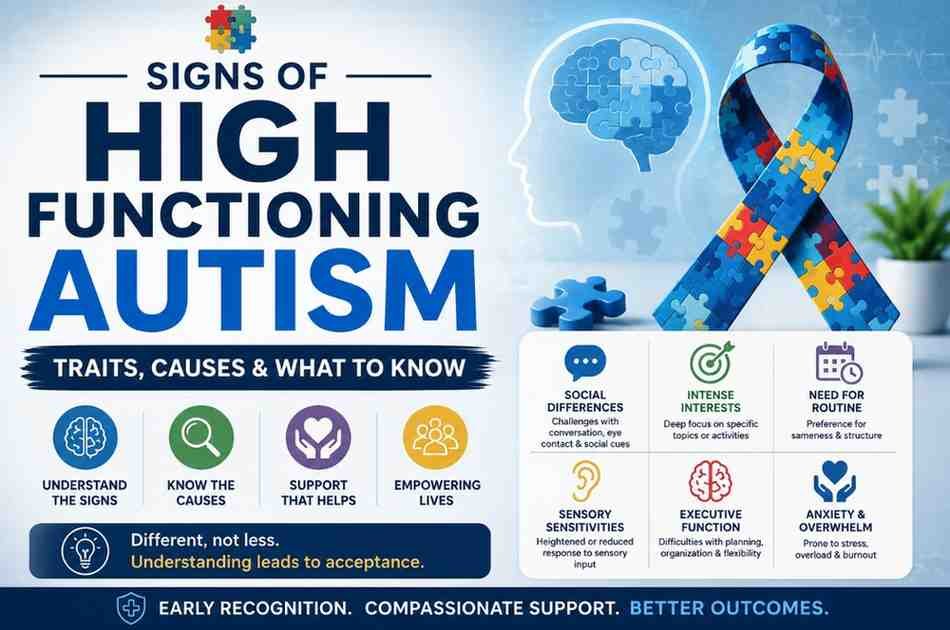
Signs of High Functioning Autism: Traits, Causes, and What They Really Mean
Autism spectrum disorder looks different in almost every person who has it, which is part of why “high functioning autism” is one of the most searched, and most misunderstood, terms connected to the condition. It’s not an official diagnostic category. You won’t find it in the DSM-5. Yet millions of parents, partners, and adults typing this phrase into a search bar are trying to answer a very specific question: does this pattern of behavior, communication, and thinking match autism, even though the person seems capable, verbal, and independent on the surface?
This guide breaks down the signs of high functioning autism as they tend to show up across childhood, adolescence, and adulthood, explains where the term came from, why clinicians are moving away from it, and what the evidence actually supports about diagnosis, causes, and next steps.
What “High Functioning Autism” Actually Means
“High functioning autism” (HFA) has never been a formal clinical diagnosis. It emerged as an informal way to describe autistic individuals who have average or above-average intellectual ability and fluent spoken language, in contrast to those with more significant intellectual or communication impairments. For years it was used almost interchangeably with Asperger’s syndrome, a diagnosis that was folded into the broader autism spectrum disorder category when the DSM-5 was published in 2013.
Today, clinicians are more likely to describe someone using the DSM-5 severity framework, which rates support needs across two domains, social communication and restricted or repetitive behaviors, on a scale from Level 1 to Level 3:
- Level 1 – Requiring support: The person can often speak in full sentences and function independently in many settings, but still struggles with initiating social interaction, adapting to unexpected change, or organizing daily tasks without some support.
- Level 2 – Requiring substantial support: More noticeable deficits in verbal and nonverbal communication, along with repetitive behaviors that are obvious to a casual observer.
- Level 3 – Requiring very substantial support: Severe communication limitations and behaviors that significantly interfere with functioning across nearly every setting.
What most people mean by “high functioning autism” maps loosely onto Level 1, sometimes called low support needs. That label is useful shorthand, but many autistic self-advocates and researchers caution against it, because it can minimize real struggles with sensory overload, executive function, anxiety, and burnout that aren’t visible from the outside. A person can look capable in a job interview or a classroom and still be exhausted, overwhelmed, or in crisis behind the scenes.
Core Signs of High Functioning Autism
Because autism is a spectrum, no single person will show every trait below, and having one or two of these characteristics doesn’t mean someone is autistic. Clinicians look for a consistent pattern that has been present since early development and that meaningfully affects daily life.
Social Communication Differences
- Difficulty reading facial expressions, tone of voice, or body language
- Trouble understanding sarcasm, idioms, or figurative language, even with strong vocabulary
- One-sided conversations, often centered on a preferred topic
- Limited or atypical eye contact
- Difficulty starting or maintaining friendships, despite wanting connection
- A tendency to take language literally, which can lead to misunderstandings
Communication Style
Many people with high functioning autism have strong verbal skills and a rich vocabulary, which is part of why the condition can be missed. Even so, subtler patterns often show up: a formal or overly precise way of speaking, a flat or monotone quality to speech, unusual rhythm or pitch, or difficulty with the back-and-forth flow of casual conversation. Some autistic individuals also process spoken instructions more slowly than written ones, or need extra time to formulate a response.
Restricted Interests and Repetitive Behaviors
- Intense, highly focused interests in specific subjects, sometimes described as “special interests”
- A strong need for routine, with distress when plans change unexpectedly
- Repetitive movements such as hand-flapping, rocking, or pacing, sometimes called stimming
- Rigid thinking patterns or strict rules around how tasks should be done
- Discomfort with transitions between activities or environments
Sensory Sensitivities
Sensory processing differences are extremely common and were formally added to the diagnostic criteria in the DSM-5. This can include heightened sensitivity to sounds, lights, textures, or smells, as well as, less commonly, reduced sensitivity to pain or temperature. A crowded grocery store, a scratchy shirt tag, or a fluorescent light can trigger genuine distress that isn’t obvious to people nearby.
Executive Function and Emotional Regulation
Difficulty with planning, organizing, and switching between tasks is common, even in people with strong academic or professional performance. Many also experience intense emotional reactions that are harder to self-regulate, along with difficulty identifying or describing their own emotions, a trait sometimes referred to as alexithymia.
How Signs Differ in Adults vs. Children
Autism is a developmental condition, meaning traits are present from early childhood even when a diagnosis comes much later. But how those traits present, and how obvious they are to others, changes significantly with age.
In young children, signs often include delayed or unusual speech patterns, limited pointing or shared attention, lining up toys instead of engaging in pretend play, and strong resistance to changes in routine. Parents researching signs in toddlers or children between ages three and seven are usually watching for these earlier, more visible markers.
By the teenage years, presentation shifts. Social expectations become more complex, and many autistic teens begin actively studying and copying peers to fit in, a behavior that can delay recognition. Anxiety, school avoidance, and friendship difficulties often become the more visible concern rather than classic early childhood signs. Families who suspect autism at this stage sometimes look for a structured Autism Test for Teens to help clarify whether a fuller evaluation is warranted.
In adulthood, the picture can look different again. Many autistic adults, especially those who went undiagnosed in childhood, have spent years developing coping strategies that make their traits harder to spot. For a closer look at how this plays out day to day, including social, sensory, and workplace patterns specific to grown adults, see this detailed guide to the signs of autism in adults.
Masking and Why High Functioning Autism Often Goes Undiagnosed
Masking, also called camouflaging, refers to the conscious or unconscious suppression of autistic traits in order to appear more neurotypical. This might look like forcing eye contact, rehearsing conversations in advance, suppressing stimming behaviors, or mimicking the social habits of peers and colleagues.
Masking helps explain why so many people with high functioning autism aren’t identified until adolescence or adulthood, and why the condition has historically been underdiagnosed in women and girls. Research and clinical observation suggest that girls and women often mask more effectively than boys and men, in part due to social conditioning that rewards compliance and social mimicry. Their special interests may also be more socially typical, such as animals, books, or celebrities, which makes the trait less noticeable to teachers and parents.
The cost of sustained masking is significant. It is strongly associated with autistic burnout, a state of profound mental and physical exhaustion, reduced functioning, and heightened sensory or emotional sensitivity that can take weeks or months to recover from. Some individuals also describe identity confusion after years of masking, finding it difficult to distinguish their authentic preferences and reactions from the persona they’ve built to get through the day.
Comorbid and Overlapping Conditions
High functioning autism rarely occurs in isolation. Research consistently shows elevated rates of co-occurring anxiety and depression in autistic adolescents and adults, conditions that are sometimes diagnosed and treated on their own while the underlying autism goes unrecognized. Attention-deficit/hyperactivity disorder (ADHD) also overlaps with autism at a higher rate than chance would predict, and the two conditions can share traits such as difficulty with executive function and sensory regulation, which sometimes complicates diagnosis.
Because of this overlap, a thorough evaluation typically looks at the full clinical picture rather than jumping to conclusions from a single symptom or checklist.
How High Functioning Autism Is Diagnosed
There is no blood test or brain scan that confirms autism. Diagnosis relies on a comprehensive clinical evaluation, usually conducted by a psychologist, psychiatrist, developmental pediatrician, or a multidisciplinary team. A typical evaluation includes:
- A detailed developmental history, often gathered from parents or close family members for adults seeking a retrospective diagnosis
- Structured observation of social communication and behavior
- Standardized diagnostic tools, such as the Autism Diagnostic Observation Schedule (ADOS-2)
- Cognitive and language assessment to rule out intellectual disability and clarify support needs
- Screening for co-occurring conditions like anxiety, depression, or ADHD
Because presentation varies so much by age and gender, and because masking can obscure traits during a single appointment, clinicians who specialize in adult or adolescent autism evaluations tend to produce more accurate results than a brief screening alone.
When to Seek a Professional Evaluation
An evaluation is generally worth pursuing when autism-related traits are lifelong, appear across multiple settings, and are meaningfully affecting relationships, work, school, or daily wellbeing. Online checklists and self-assessments can be a useful starting point for organizing your thoughts before an appointment, but they cannot diagnose autism on their own. A licensed clinician is the only reliable route to a formal diagnosis, and a diagnosis, when appropriate, often opens the door to accommodations, therapy, and community support that can meaningfully improve quality of life.
Frequently Asked Questions
What is the difference between high functioning autism and Asperger’s syndrome?
Asperger’s syndrome was a separate diagnosis used before 2013. When the DSM-5 was published, it was merged into the single category of autism spectrum disorder. Many people who would previously have received an Asperger’s diagnosis are now described as having Level 1 autism or, informally, high functioning autism.
Can adults be newly diagnosed with high functioning autism?
Yes. Many adults, particularly women and people who masked effectively in childhood, are not diagnosed until their twenties, thirties, or later. A diagnosis at any age can bring clarity and access to appropriate support and accommodations.
Is high functioning autism the same in men and women?
Not exactly. Autistic women and girls often present with subtler social masking, more socially conventional special interests, and higher rates of misdiagnosis with anxiety or depression before autism is identified, which contributes to later diagnosis compared with men.
Can someone with high functioning autism live independently?
Many people who fit this description do live independently, hold jobs, and build relationships, though it can require significant effort, coping strategies, and, at times, ongoing support with specific challenges such as executive function or sensory regulation.
Does having a few of these traits mean a person is autistic?
No. Many of these traits, especially in isolation, occur in the general population and can also stem from anxiety, ADHD, or personality differences. A pattern that is lifelong, occurs across multiple settings, and causes real difficulty is what a clinician looks for, not any single trait on its own.
Final Thoughts
The signs of high functioning autism span social communication, sensory processing, emotional regulation, and behavior, and they look different depending on a person’s age, gender, and how much energy they’ve spent masking to fit in. The term itself is informal and increasingly replaced by the DSM-5’s support-level framework, but it remains a useful starting point for people trying to understand a pattern of traits in themselves or someone they care about. If these signs sound familiar and are affecting daily life, the next step is a conversation with a qualified clinician who can look at the full picture and guide you toward an accurate diagnosis and the right kind of support.